
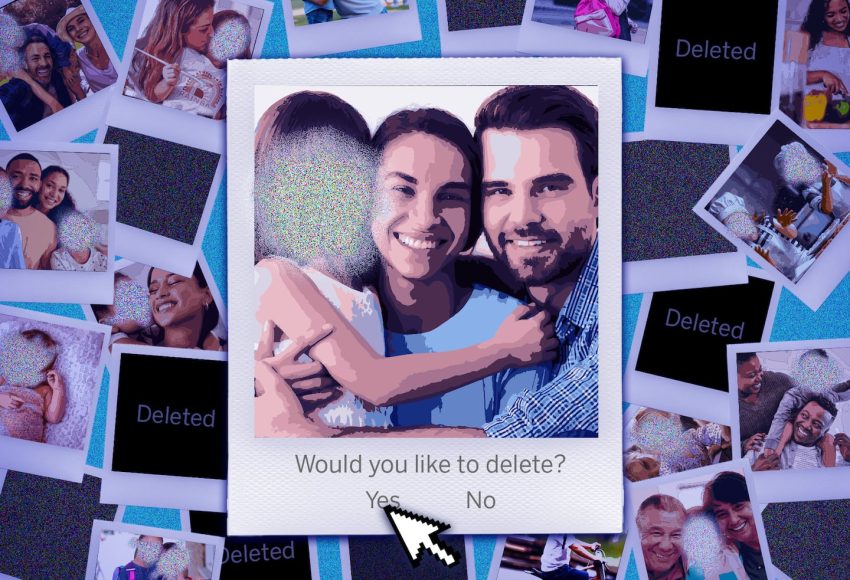
“EFFECTIVE IMMEDIATELY,” a family photographer announced, “I will no longer be posting identifiable images of children.”
Debates about digital privacy and the hazards of putting children’s faces online have been taking place for decades, ever since Phillippe Kahn instantly shared the first camera phone photo of his newborn daughter from the delivery room in 1997. A subset of parents already blur their kids’ faces, use emojis to cover them, or keep photos offline entirely.
But now, the rise of AI-generated explicit images and a recent, somewhat counterintuitive, federal court ruling have heightened the stakes.
“There were dangers about it from the get-go,” said Jenn Adams, a Burlington, Vt.-based family photographer. “This has only elevated it exponentially.”

The discussion was largely predicated on a federal appeals court ruling out of the Seventh Circuit late last month, which found that under current law, it is legal to possess images or videos of child sexual abuse created using AI — if the images depict virtual children and stay inside the home.
That ruling involved a Wisconsin man, Steven Anderegg, who allegedly used an AI image generator on his hard drive to create thousands of explicit images of children. In 2024, Anderegg was charged with producing, possessing, and distributing obscene images on Instagram. After a Wisconsin judge dismissed the possession charge, federal prosecutors appealed.
Judge John Z. Lee, writing for a three-judge panel, found that the First Amendment protected an individual’s right to privately possess virtually created images of child sex abuse material, or CSAM, in their home. (Anderegg still faces production and distribution charges.)
Lee essentially argued the judges’ hands were tied thanks to three precedent-setting Supreme Court cases, notably Ashcroft v. Free Speech Coalition, which in 2002 found it legal to possess virtual child pornography.
AI technology to create virtual images of children wasn’t widely available at the time of the Ashcroft ruling, which was something of a sticking point.
“Given the relentless advancement in artificial intelligence models, we have some concerns about the lines these cases draw, but we are not free to redraw them ourselves,” Lee wrote.
Jessica Schidlow, a children’s law and policy expert with the Boston-based advocacy group Enough Abuse, said the ruling was narrow, only applicable in instances where a virtual, AI-generated abuse image “is created and not distributed or transferred, and you use it only for your own in-home viewing purposes.” But she said the decision highlights how tenuous the current legal landscape is.
“The court was very clear on how distraught it was on having to rule this way,” she said.
Daniel Lyons, an internet law professor at Boston College, agreed. “The Seventh Circuit was practically begging the Supreme Court to take it up,” he said.
While legal scholars have been assessing the ramifications of the ruling, the public has been grappling with the practical implications. The complicated nature of the decision led many to believe any family photo of a real child can be put in an AI tool to make explicit imagery.
But that’s not actually the case, said Stanford cybersecurity fellow Riana Pfefferkorn.
“It’s not about real children, it’s only about imaginary, virtual children,” she said. “There’s a lot of hype and overstating and I’m frankly not surprised and not bothered by this ruling.”
Pfefferkorn said prosecutors “will have no trouble bringing people to justice” in cases similar to the Anderegg one.
But AI-ethicist Catharina Doria said the ruling highlights a larger problem. Because AI models are trained on existing images on the web, even explicit images of “virtual children” are based on photos of real kids. Her Instagram warning to parents has been viewed over a half-million times.
“Companies are scraping [users’] data,” she said in an interview, “and 100 percent of this data can be used to create AI-generated CSAM.”
It was online postings like Doria’s that prompted Robyn Lee Miller of Longmeadow to act.
“I went all mama bear,” she said, and began archiving photos of her 8-year-old daughter on her Instagram account. Miller, who works in digital marketing, said she’s not naive about how things can spread online. But the court decision was a turning point.

“I feel very disgusted and disturbed by this ruling,” she said. “Anything that could be used in a malicious way, it’s coming down.”
Amy Williams, a Milford-based trauma therapist, is also shifting how she posts. “One thing that most people don’t know or consider when it comes to posting children on the internet is that childhood sexual abuse most frequently involves perpetrators who already know the family,” she said. “More than likely it’s someone on your social media friends list.”
Williams said her decision has led to tough conversations with close friends and relatives about not sharing photos of her kids.
“I hate to take that away from them,” she said. “That was a conversation I was avoiding until AI.”
As concerns about the Seventh Circuit’s ruling spread online, another video from Utah influencer Kalie Robins was adding fuel to the fire. In a post that’s now garnered over 6 million views, Robins shared how disturbed she became after Meta AI prompts began to serve up personal details about her daughter, even going so far as to pull up previously deleted photos from the web.
“I didn’t ask Facebook to build a profile of my family,” she said. “I posted a video of me in the car singing with my kid.”
Meta told Business Insider the AI prompts were a mistake and have been fixed, but the viral conflagration grew.
“If nothing up until this point has made influencers take their kids off the internet, it should be this,” said Alexandra Lains, whose cultural commentary often focuses on the perils of AI. “I’m sorry but if your income depends on millions of strangers having access to your kids, get a new job.”
That’s not an option for Jessica Haynes McDaniel, who has spent two decades cultivating her family portraiture business, Boston Baby Photos. McDaniel said parents used to jump at the chance to have her post cherubic photos of their kids on her platforms, but now less than a quarter sign her release forms.
It’s gotten to the point where she runs free giveaways each year to parents willing to share their kids’ photos online, just to ensure she’ll have enough content to promote her work. McDaniel understands parents’ concerns, and sees the irony of the situation.
“I need to create content in order to get people to hire me,” she said. Now AI worries are threatening her business model, and “just one more nail in the coffin.”
Adams, the Vermont-based photographer, said she no longer feels comfortable feeding the AI machine. She said online that she would no longer put images of children on her platforms.
“For me, it kind of feels pointless to go through and basically erase my whole portfolio from social media,” she said. “But going forward, I’m not going to add to the problem.”
But some photographers are erasing years of images. After the court ruling, El Paso-based photographer Blanca Gonzalez archived 2,700 photos from her Instagram account, going all the way back to 2013.
“I was getting rid of memories and clients that have become friends and their kids,” she said. “It was a little heart-wrenching as an artist.”
It’s bittersweet for many parents too. “I think it’s really sad that we’re watching children’s faces slowly disappear from the internet,” Devan Smalley wrote on Instagram this month.
“I was seeing more and more friends and acquaintances . . . subtly taking their kids faces off of social media,” she said. “To me it is sad, but there is a truth behind it.”
As a parent herself, Schidlow hates to see people grappling with fears about AI and potential abuse. “We want a sense of control but we really have none,” she said. “That is the scariest part.”
Efforts to better regulate the tools should be directed toward Congress, she said. “This can’t be on parents’ shoulders, it can’t be on schools’ shoulders.”
Lyons, the BC professor, acknowledged that the number of children whose pictures are online “versus the number of kids who actually wind up being victims is probably a very small ratio.” But he still struggles with what to tell parents.
“I wouldn’t stand out there and say don’t put your kids’ pictures online,” he said. “But I wouldn’t say it’s without risk either.”
Janelle Nanos can be reached at janelle.nanos@globe.com. Follow her @janellenanos.