
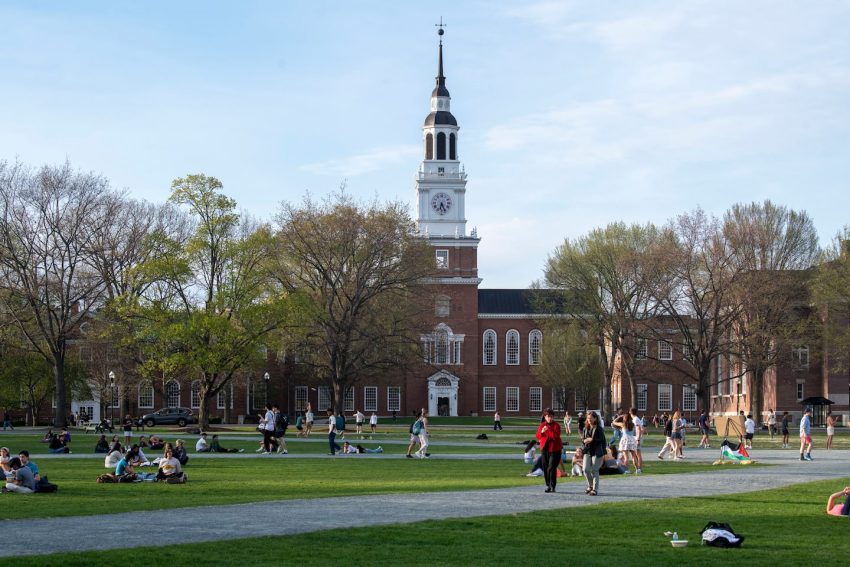
Ben Stevenson, a Dartmouth senior majoring in history, described recent developments as “Orwellian.”
“Dartmouth is claiming to be a national leader, but really Dartmouth is a national embarrassment,” he said.
Last month, Schnell, who has been on the job a little over a year, wrote an op-ed for the Washington Post titled “Universities are fighting AI cheating. But there’s a deeper problem.”
There was, indeed, a much deeper problem — just not the one Schnell opined about. The AI detection tool Pangram later identified his piece as 100 percent AI written, according to an analysis of AI writing in national publications by the news platform Semafor that ran Aug. 26.
Schnell told Semafor that his Post essay was based on his own thinking, and that he used ChatGPT “to refine a few arguments, check for grammatical errors, and submit it,” before going through multiple rounds of editing. A native of Venezuela, he also noted there is evidence AI detectors “are biased against non-native English speakers, such as myself.”
The scandal seemed to have died down — until Monday. That’s when student reporters at Dartmouth published their own exposé looking into several opinion pieces and academic articles published by Schnell in 2026. They found a median “AI-written” text percentage of 96 percent, according to Pangram, which boasts a near-zero false positive rate.

Making matters worse, when Schnell responded to the allegations in an emailed statement to the student paper, The Dartmouth, the young journalists ran that through an AI detector — and found it was 100 percent AI-written.
In other words, according to The Dartmouth, a provost accused of using AI to write an op-ed about using AI even used AI to write a statement defending his use of AI. Or, as one Reddit user put it: “Dartmouth Provost caught using AI for everything.”
“It’s a textbook case of exactly what we tell our students not to do,” said Christopher MacEvitt, a Dartmouth professor of religion and chair of the department. “I mean, my jaw literally dropped when I read the reporting in the student paper because it just so encapsulates everything that we fear is happening at Dartmouth. It’s like, oh, yep, it really is.”
“In retrospect, I now realize I should always explicitly disclose use of AI in my public writing and be attentive to the expectations of AI use set by publications,” Provost Schnell said in a statement to the Globe sent Thursday night. “I am sorry that this was not my standard practice and, moving forward, it will be.”
On Friday, The Dartmouth published a letter to the editor by Schnell expressing similar sentiments. “I did personally run it through Pangram,” said Eli Moyse, the student columnist who called for Schnell’s firing. “It came back as 100 percent human written, which I guess is a step in the right direction.”
“The questions this moment raise go well beyond any one person,” Beilock said in a statement Thursday. “Thoughtful people on our campus can and should disagree about those norms, which are rapidly shifting. It is more clear than ever that we need role-appropriate rules and policies for this technology.”
Beilock then sent a campus-wide email Friday announcing she would be launching “a rigorous, objective review of how [Provost Schnell] has used AI, measured against the criteria of the publications to which he submitted his work. He is taking this matter seriously, as am I.”
The scandal brings to light the importance of human intelligence and ethics as we hurtle toward an unregulated AI future. Global tensions are already high with many business and political leaders sounding the alarm over the dangers of AI. Suddenly, the discourse has turned toward end times at the precise moment the college is touting itself as the place where it all began — the 1956 Dartmouth Summer Research Project on Artificial Intelligence is widely considered a seminal event for the field.
Last year, Dartmouth became the first Ivy League school to launch AI “at an institutional scale,” partnering with Anthropic and Amazon Web Services, according to the college’s website, which notes AI is now being used by faculty across campus, while a faculty leadership group “ensures the technology serves Dartmouth’s educational mission, not the other way around.”
But critics of the college administration say it is exactly the other way around.
When rules around AI use are treated as “optional for people in power, what exactly is the college expecting its faculty to be saying to its students?” asked Bethany Moreton, a professor of history at Dartmouth. “We are a liberal arts college. If we can’t come up with a form of humanistic classroom experience and intellectual guardrails that can function in this moment, then I don’t know who we are asking to do that task for us.”
The Dartmouth chapter of the American Association of University Professors is now circulating a petition to the college president and trustees on behalf of Dartmouth students, faculty, parents, and alumni, calling for the removal of Provost Schnell. “How do we ask our students and colleagues to follow the rules,” they ask, “when the academic leader of Dartmouth is allowed to break them?”
Meanwhile, in a recent opinion piece for The Dartmouth, alum Unai Montes-Irueste accused Beilock of trying to sell “a pro-AI Dartmouth to prospective students and donors, and propagandize alumni and the public.”
Many people in the Dartmouth community see “a tremendous hypocrisy” in how college leaders talk about using AI ethically versus how they put it into practice, Montes-Irueste, told the Globe.
It’s been a “terrible September” for Beilock, said MacEvitt. He noted that Jacob Weisberg’s book, “Profiles in Cowardice: A Study of Collaboration in the Trump Era,” frames Beilock as a capitulator-in-chief, “echoing criticisms that faculty have been making over the last few years.”
“Now,” said MacEvitt, “this is coming immediately on the heels of that.”

Much of the focus has been on students when it comes to AI and ethics, but Schnell’s case has “as much to do with enforcing rules on students that one violates oneself,” said Dorothy E. Leidner, a professor of business and AI ethics at the University of Virginia McIntire School of Commerce.
“There is a debate about whether writing itself is authorship,” she wrote in an email.
She noted many researchers use graduate students to build the intellectual foundation of their work, but then the researcher writes a paper and gets the credit.
“One could argue that the provost in this case is merely the minion doing the busy work for the AI, which then authors the paper,” Leidner said, adding that Schnell is essentially arguing the opposite — that AI is the minion, and he is the real author.
“I personally believe that the very art of crafting a paper is a huge part of authorship,” she wrote. “When one crafts thoughts into words, one is also shaping thoughts . . . So I do not accept the argument that the writing itself is not a big deal. It’s a huge part of the intellectual process.”
In addition to provost, Schnell is a professor of mathematics, and adjunct professor of biochemistry and cell biology and biomedical data science, according to his Dartmouth biography, which notes that “he has served on the editorial boards of ten leading scientific journals.”
One of the cited articles in Semafor’s investigation, which examines guest columns in publications including the New York Times and Wall Street Journal, is Schnell’s Washington Post piece urging universities to help students develop critical thinking skills while teaching them how to intelligently use AI. Dartmouth clearly states students “may not use GenAI tools for submitted coursework unless expressly permitted” in its own policy, and notes that generative AI often demonstrates “a human-like touch of creativity.”
Weeks passed after the Semafor piece ran. Then came The Dartmouth’s exposé. The students reviewed several articles and essays authored by Schnell before and after the public debut of ChatGPT in November 2022. “Pangram 4.0, the latest publicly available version of the AI detector, labeled all of Schnell’s written works prior to 2022 as ’100% human-written,’ while a test of nine of his works published this year returned a median ‘AI-written’ percentage of 96%,” wrote reporters Alex Klee and Isabela Pierry.
Once again, Schnell defended himself. On Sept. 18, according to The Dartmouth, he emailed a statement to the newspaper explaining he uses AI to refine his writing and making the process more efficient, but that he takes responsibility for its content.
“I regard these technologies as assistive tools,” he wrote. “They do not identify the problem, design the research project, guarantee the validity of research results, interpretations, citations, conclusions or substitute for my research, intellectual judgment or authorship.”
After Schnell’s Sept. 18 email, he then sent the student paper another statement justifying his use of AI to write his earlier statement.
“I mean, you couldn’t write it better in terms of a cautionary story,” said MacEvitt.
As for Schnell’s assertion that AI tools are biased against non-native speakers, Leidner, the AI scholar, rejects that theory.
“He seems to be arguing that Pangram flags work written by non-native speakers as AI-generated. I’d like to see some proof of this because it seems backwards — AI is so good at producing grammatically correct English that, if anything, one would expect non-native English writing to NOT be flagged as AI-generated for the very reason that it has grammatical irregularities,” she said in an email.
Unlike spellcheck or Grammarly, generative AI tools do much more than polish writing: They completely rewrite full sentences and paragraphs, and in doing so, the end result can “diverge significantly” from the human mind, she said. “Regardless of whether it is ‘good’ or not, writing is only human when it is a true representation of a person’s thoughts.”
As Dartmouth deals with such questions in real time, “It kind of feels like a precedent is going to be set,” said Stevenson, the history major. “Then the question is, how will other academic institutions follow, or not follow, the lead of Dartmouth?”
Brooke Hauser can be reached at brooke.hauser@globe.com. Follow her @brookehauser.