

An Alaska Airlines Boeing 737-900 takes off from Los Angeles International Airport en route to San Francisco on Sept. 18, 2026.
In the latest air travel developments, the Federal Aviation Administration has started to deploy new artificial intelligence-based technology into the nation’s air traffic control system to reduce flight delays; the Transportation Department secretary says he wants another $30 billion from Congress for even more air traffic control improvements; Alaska Airlines plans a new route from San Jose to Seattle’s northern suburbs; Southwest plans to add new service from Santa Rosa to Texas next week; Delta announces a big expansion at LAX next year; United puts one of its new premium 787-9s onto the SFO-Seoul route, and adds more capacity from SFO to Australia; American Airlines starts code-sharing with Taiwan’s Starlux; United brings live-streamed football to its Starlink-equipped planes; the Priority Pass airport lounge program says it will add more locations and customer technology enhancements; Sacramento International Airport plans to raise customer parking fees.

The Trump administration’s promise to revolutionize the nation’s air traffic control system took a step forward this week as the Federal Aviation Administration introduced a new, AI-based technology called Strategic Management of Airspace, Routing and Trajectories (SMART). The initial deployment of the $875 million system is limited to the three Washington D.C.-area airports — Dulles, Reagan National and Baltimore-Washington. The FAA said SMART’s artificial intelligence “centralizes 200 data streams — including weather patterns, flight paths, traffic flow, and controller staffing metrics — into one platform.” It then “synthesizes all this data to provide a comprehensive visualization of where planes are going, how much traffic the system can handle and where congestion or weather could cause challenges. Aviation specialists can use the platform to see what conditions will be in the future and make recommendations to fix the problems before they arise.” By preventing air traffic bottlenecks and backlogs, the system should reduce flight delays and cancellations, the agency said.
Article continues below this ad
According to the New York Times, “Transportation Department officials stress that the SMART system will not replace human operators or direct any changes to flight routes, but merely offer recommendations that controllers can choose to heed or ignore.” Simple Flying said SMART will function “as a decision-making support tool during complex operational disruptions,” but “in the future, iterations will be expected to intervene for complex tasks, including managing flight arrivals and intervals, while also planning out aircraft mapping routes days in advance.” Not everyone was happy about the SMART deployment: Virginia Democratic Rep. Don Beyer, who represents the district that includes Reagan National Airport and also co-chairs the Congressional Artificial Intelligence Caucus, said the FAA “should not use my constituents as guinea pigs for an unproven AI air traffic control system.” Beyer said he was told “that air traffic controllers were not consulted on the ‘SMART’ system’s design and development, and were not trained on using it prior to the system’s adoption at local airports.” He called on the administration to suspend the use of SMART until it is proven “via air traffic controller feedback and independently verified stress testing that the technology is safe.”

The air traffic control tower at Los Angeles International Airport on Sept. 18, 2026.
SMART’s $875 million price tag is just a drop in the bucket compared to the Transportation Department’s larger plans for air traffic safety. According to Reuters, DOT Secretary Sean Duffy said this week he plans to ask Congress for another $30 billion to be spent on replacing air traffic control towers at the nation’s airports, installing new telecom and other communications systems, and improving traffic control software like the SMART system. Simple Flying said that the $30 billion request would be in addition to the $12.5 billion that Congress approved last year for air traffic control improvements. It noted that Duffy’s remarks came just a day after a major communications failure “paralyzed traffic along the east coast” on Sept. 21, with thousands of flights delayed or canceled at Newark Liberty, New York JFK and LaGuardia and Philadelphia International airports.
Travelers from the South Bay are set to get a new flight option to the Pacific Northwest next spring
Article continues below this ad
In other domestic route news, Southwest Airlines, which currently flies from Sonoma County’s Charles M. Schulz Airport in Santa Rosa to Las Vegas, San Diego, Burbank and Denver, plans to add a new destination on Oct. 3 when it introduces weekly Saturday service to Austin-Bergstrom Airport in Texas, according to the Points Guy. We reported last week on Delta Air Lines’ plan to launch new twice-daily intrastate service between Monterey and Los Angeles International in December, but that’s only part of the airline’s upcoming expansion at LAX. Delta said last week it will begin another transcontinental route from LAX next year and increase capacity on several other domestic routes. On June 7, the airline plans to launch one daily roundtrip between LAX and Philadelphia, and from April through July it plans to phase in expanded frequencies on other LAX routes, including a second daily flight to Raleigh-Durham and to Cincinnati; a third to Houston and to San Antonio; a fifth to Boston and to San Diego; and an eighth to Seattle. On Oct. 1, United Airlines is due to put one of its new Airbus A321XLRs into service on one daily flight between Los Angeles International and Washington Dulles, continuing through Nov. 30.

Attendees pose for pictures in the Polaris business class seating of a United Airlines Boeing 787-9 during a media event at Los Angeles International Airport on March 24, 2026.
In international route developments, Aeroroutes reports that United Airlines has deployed one of its new 222-seat 787-9s with expanded premium seating and a new Polaris cabin onto the San Francisco-Seoul Incheon route, operating one of its two daily flights. Starting Sept. 24, United increased its San Francisco-Brisbane, Australia, schedule from four flights a week to seven, using a 777-200ER. Japan Airlines’ low-cost affiliate Zipair Tokyo has started taking reservations for a limited winter schedule from San Jose Mineta to Tokyo Narita; the carrier plans to operate three flights a week from Dec. 18 through Jan. 3, then two a week through March 3. After March 15, it plans to go back up to three times weekly. At Los Angeles International, Austrian Airlines is due to end its summer seasonal service to Vienna after Sept. 30.
Aeroroutes reports that American Airlines and Taiwan’s Starlux Airlines will begin a code-sharing partnership on Sept. 30 that will put the AA code onto Starlux flights to Taipei from San Francisco, Los Angeles, Ontario and Seattle, and add the Starlux code to dozens of American’s domestic flights. The Points Guy said American has confirmed that the new partnership will also extend to loyalty programs, so that American AAdvantage members will earn miles and loyalty points when they buy an AA code-share flight on Starlux.
Article continues below this ad
United Airlines has expanded its in-flight entertainment lineup by teaming up with Dish to offer live-streamed football games on the seatback screens of aircraft equipped with Starlink Wi-Fi. The coverage will include both professional and college games broadcast by ABC, CBS, NBC, Fox, FS1, ESPN, ESPN2, NFL Network and TNF on Prime Video, United said in a news release. So far, the airline has installed Starlink on more than 220 mainline planes operating up to 700 flights a day, and expects to have the service on nearly 700 aircraft by February for the Super Bowl. Onboard Starlink Wi-Fi is offered free to members of the airline’s MileagePlus loyalty program. The company sponsors nine teams in the NFL, and expects to operate charter flights for 11 teams this season.

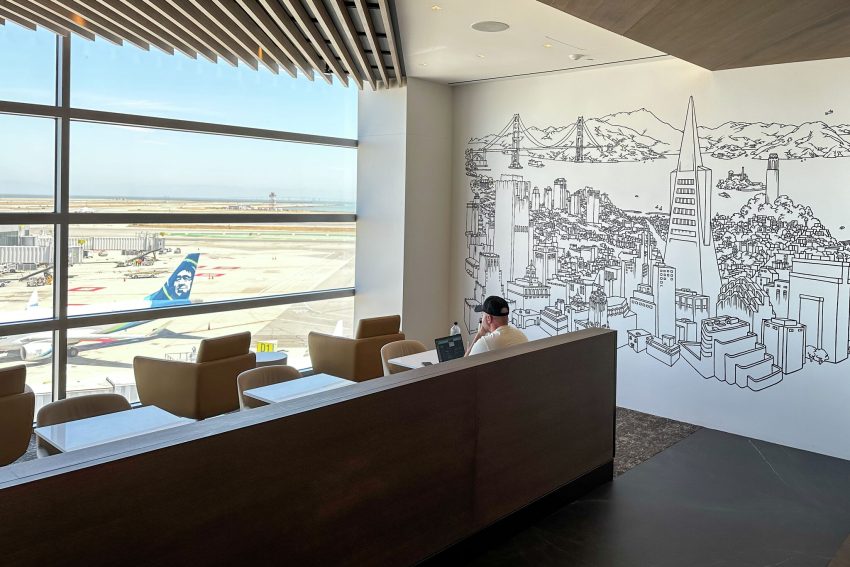
A mural by San Francisco artist Amos Goldbaum at Air Canada’s Maple Leaf Lounge at SFO.
Priority Pass, the membership plan providing access to airport lounges worldwide, said it will add more locations to its lounge roster and introduce technological enhancements for customers as part of a $660 million growth program adopted by its parent, the Collinson Group. With 1,900 locations already in its network, the company said it expects to expand “significantly,” although it didn’t estimate how many lounges it would add. “This additional lounge capacity within the group will help to protect and enhance the experience available to Priority Pass members as global air passenger traffic is expected to almost double to nearly 19 billion journeys a year by 2045,” Priority Pass said in a news release.
The company’s planned improvements include “leveraging AI, past behaviours and real-time geo-location (where enabled) — to proactively suggest suitable lounges and travel experiences for members’ journeys” in its new Priority Pass+ App. Priority Pass membership is included in some high-end credit cards’ benefits, and the company also sells individual memberships at three levels ranging from $99 to $469 a year. Another growth product for the company is its Airport Fast Track service, “providing access to expedited security lanes through the Priority Pass app.” Now offered at 28 airports, “the network is expected to expand to more than 170 bookable fast track lanes across more than 150 terminals and more than 130 airports globally” in the next 12 months, Priority Pass said.
Article continues below this ad
In airport news, Sacramento International said it will raise parking rates later this year when its new Parking Garage 2 opens. The daily parking rate is set to increase from $12 to $14 for economy lots, from $14 to $19 for the daily lot, and from $21 to $28 for garage parking. Those rates will hold through 2027, the airport said, but starting Jan. 1, 2028, all rates will go up by $1 a year through 2031. “These investments are delivering the improvements our passengers have asked for; more spaces, more covered parking, easier ways to pay and a faster, more predictable parking experience,” said Sheri Thompson Duarte, the airport’s deputy director of operations and public safety.