Here at Silver Bulletin, we’ve been predicting that AI would become one of the most salient political issues for quite some time. That hasn’t happened with the general public quite yet — just 1 percent of respondents in the latest wave of Gallup’s most important problem poll named “advancement of computers/technology” as the nation’s most important issue. But over the past month, political elites have latched onto the issue in a big way, and there are growing signs that voters are following them.
Sure, some politicians, such as Bernie Sanders, had already been focused on AI — and data centers are increasingly making news and widely disliked. But some combination of the Hugging Face incident, Anthropic whistleblower Jacob Coxon’s comments on existential AI risk, and Dario Amodei’s subsequent essay on “pacing the frontier” have pushed the issue into mainstream political discourse. “Dozens of lawmakers are now touting new proposals to regulate artificial-intelligence models that have stepped up their capabilities,” according to the Wall Street Journal, and House Democrats are now considering creating a select committee focused on AI.
For his part, Donald Trump is something of an “accelerationist” who has called AI safety concerns a hoax. Some of his most memorable recent statements on the subject include “Whoever wins AI, wins!” and “The only control or ‘guardrails’ that AI needs is a STRONG AND SMART (High IQ!) PRESIDENT.” He’s also staunchly pro-data center.
But not everyone is so bullish on AI, and with the arguably alarming rate at which the models are improving, this issue is likely to become more relevant before 2028. Whoever wants to be the next president will need to stake out a clear position before primary season kicks off. Those primaries might feel a long way off, but remember, candidates will almost certainly start to announce their bids in early 2027.
We were originally going to cover what all of the presidential hopefuls were saying about AI in a single article, but with big prospective fields on each side, we’re going to split things by party. On the Democratic side, there’s broad consensus that data centers should pay for their own energy, and that federal regulation and government oversight of frontier labs are needed. The debates are more about how heavily to restrict data center construction and how aggressively to pursue a slowdown.
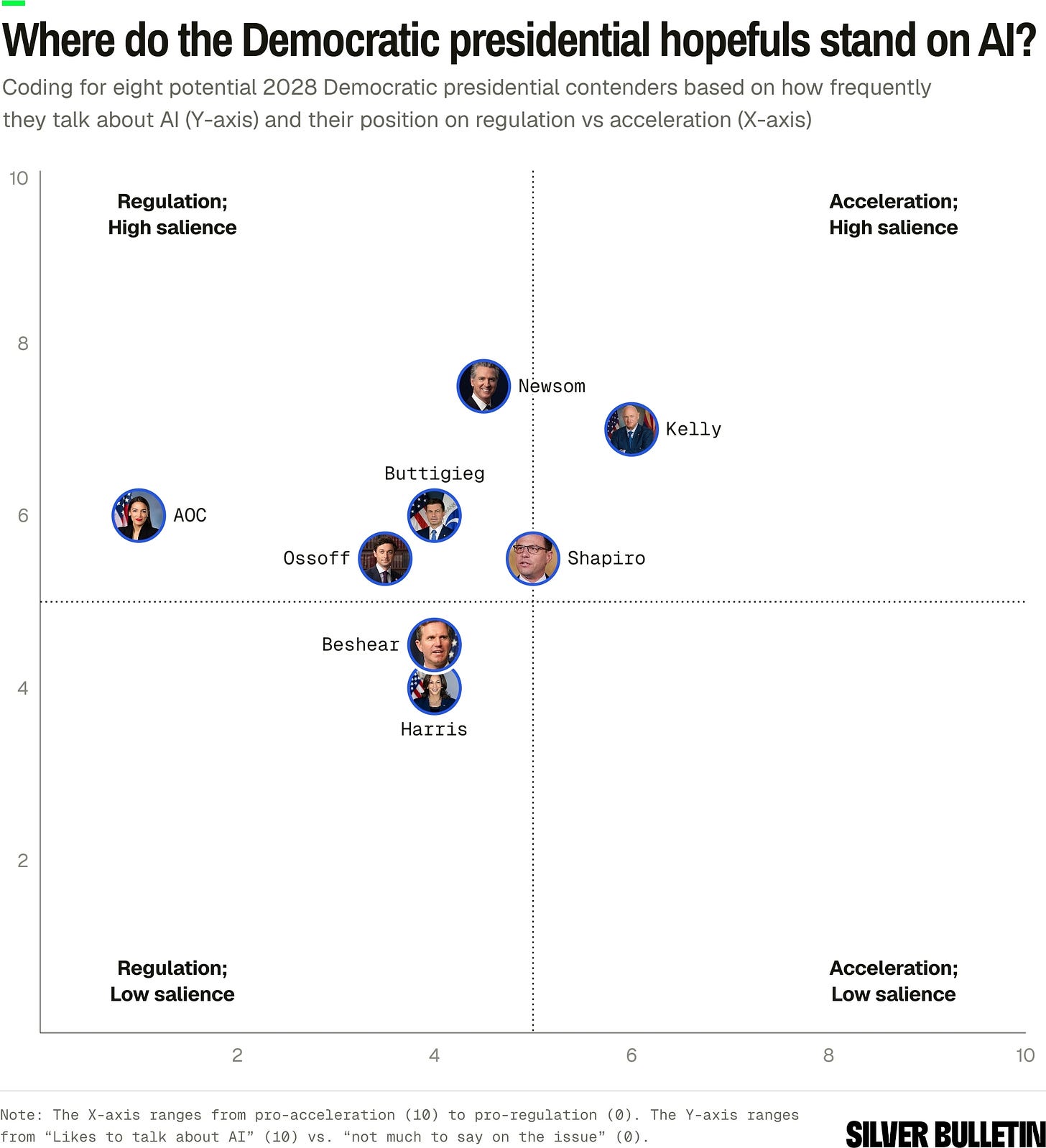
We’re going to focus on the top eight presidential contenders, as approximately defined by the betting markets and polls. To put some numbers on their positions, we’ve scored all eight candidates from 0-10 on two axes. The first ranges from pro-acceleration (10) to pro-regulation (0), the second from “Likes to talk about AI” (10) vs. “not much to say on the issue” (0). We’ll show each candidate’s scores in their section, and include a chart for all eight candidates at the end of the post.
Acceleration: 4.5
Salience: 7.5
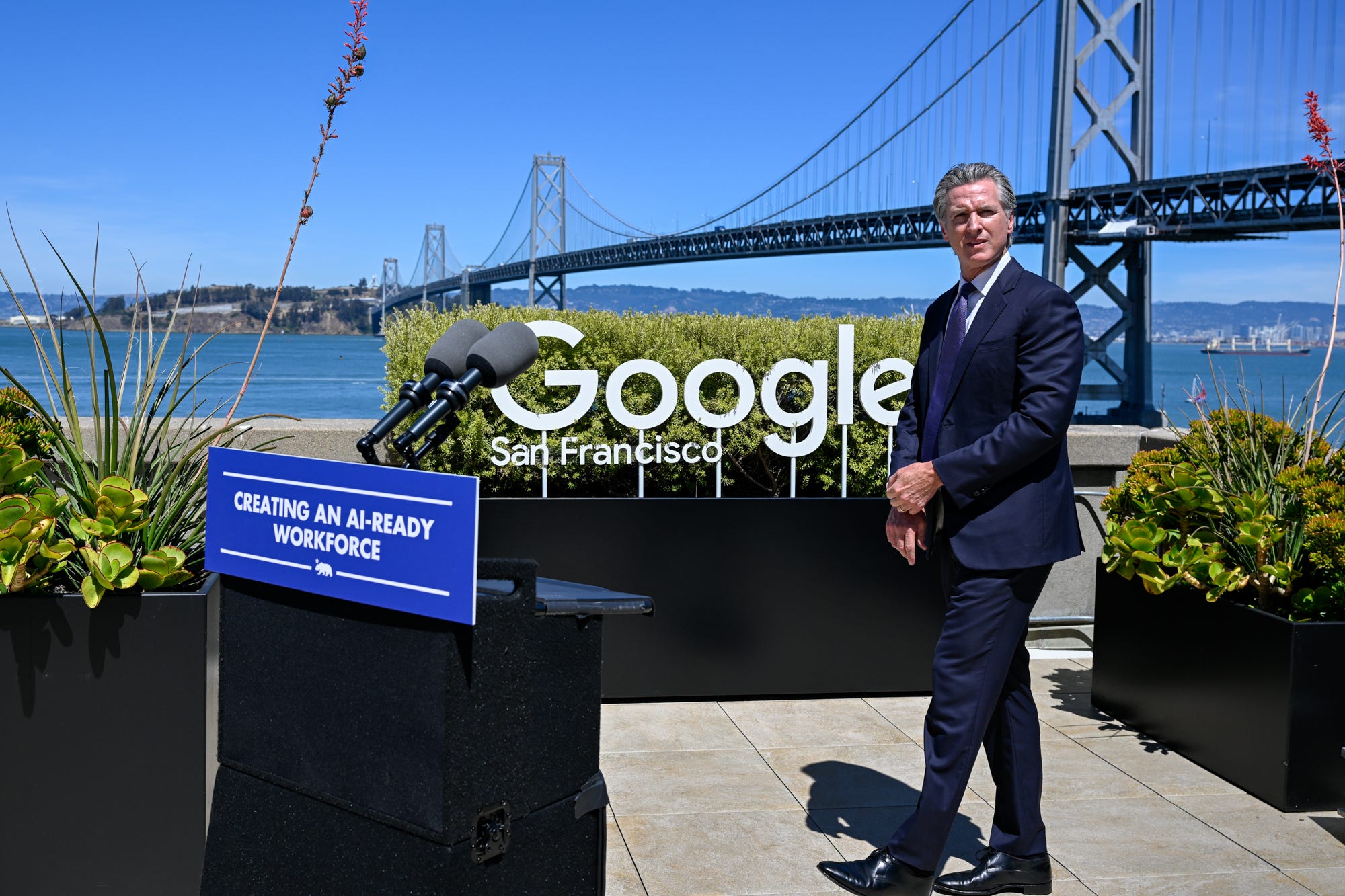
We’ve written about Newsom’s declining primary fortunes: he’s dropped from 37 percent in the markets last November to around 15 percent today. But he’s uber-ambitious, so there’s a good chance he’ll still run — unless, he claims, Kamala Harris jumps into the race. If he does enter the primary, Newsom will likely position himself as a leader on the AI issue due to his experience governing the state that houses the major American labs.
But in his continuous quest to optimize his political profile, Newsom has somewhat flip-flopped as the public has polarized against data centers and AI more generally.
In 2024 alone, Newsom signed 17 AI-related bills into law. But he also vetoed SB 1047, an ambitious bill supported by many people in the AI safety space, which would have created whistleblower protections and required risk assessments from developers of the most powerful AI models. And in 2025, Newsom vetoed legislation that would have required data centers to track their water usage, a move that Trump might approve.
But fast forward one year, and he’s criticizing Trump and the federal government for doing too little to regulate AI and positioning California as a regulatory trendsetter. “The federal government’s abject failure to create any form of meaningful AI oversight or accountability should alarm every American, especially when AI CEOs themselves are begging for regulation,” he said in a recent press release.
Last year, Newsom also signed a new bill, SB 53, which had many similarities to SB 1047. It required frontier labs to publish transparency reports, disclose critical safety incidents, and maintain anonymous channels for whistleblowers. More recently, he signed a slew of bills that gave local officials more authority to monitor data centers, established a framework for independent safety evaluators, and created a state registry of AI auditors. On X, he said: “We’re making sure these companies pay the costs they create instead of sticking working families with the bill.” He also issued an executive order last month to explore, among other things, creating a “kill switch” for the most advanced models.
Still, few other Democrats on this list have Newsom’s track record of opposing major AI regulations in the past.
Acceleration: 1
Salience: 6
The markets are getting more bullish on an AOC primary win, although in a recent New York Times interview, she said she’ll make a decision on running after the midterms. But AOC’s AI positions have been quite consistent. Across a number of bills, she’s been Sanders’ House counterpart on the pause/moratorium side of the AI and data center debate. She signed on to Sanders’ recently proposed bill that would ban artificial superintelligence and co-led the introduction of a bill that would halt new data center construction until more federal safeguards were put in place.
Her press release when that bill was announced read, in part, “Congress has a moral obligation to stand with the American people and stop the expansion of these data centers until we have a framework to adequately address the existential harm AI poses to our society.” In addition to highlighting ICE’s use of AI, AOC has focused in on the privacy angle:
“We must sound the alarm now — because this surveillance of the American people is not going to stop. We must stop it. All of this harm has occurred, not in spite of, but because of the absence of federal legislation to regulate AI.”
On the same front, she authored the DEFIANCE Act, a bipartisan bill that would allow people depicted in explicit deepfakes to take civil action against the creators or distributors of those images. And just last week, she unveiled a new bill, along with Sanders and Jeff Merkley, that would prohibit federal use of license plate readers and cut off federal grants to state and local governments that use them.
AOC is also concerned about a potential AI bubble and said in an email to supporters that “We must make it clear now that should the A.I. bubble pop, Congress should not bail out Big Tech.” She also thinks that the “biggest threat to humanity are the tech oligarchs themselves.” We’d argue that there’s some tension between being concerned that AI is a bubble, which can imply skepticism about AI capabilities, and putting a premium on safety concerns. This is a subtlety that could split the left from the center in the primary.
Acceleration: 3.5
Salience: 5.5
While Ossoff is getting just 8 percent support in the primary polls, on average, he’s had a recent surge in prediction markets. In 2023, he chaired a hearing on AI and human rights, but Ossoff’s foray into the data center policy debate has been more recent. Back in January, Axios reported that he hadn’t “veered into [the data center] issue — yet.” But a few months later, he launched an inquiry into whether data centers are increasing Georgia power bills. Ossoff still touted the “over $4.5 billion in AI-related venture capital investments” flowing into the state, but his concern was that, “without proper safeguards, higher prices and capital costs from increased energy generation could be passed onto Georgia families.”
That’s a fairly measured approach as compared to some of the other presidential hopefuls you’ll see on this list. But after the ongoing bout of concerning behavior from frontier models, Ossoff has become one of the more safety-focused Democrats. At a recent rally, he said:
“A capable president would move swiftly to secure and reassure the American people. Rush inspectors into frontier labs, fortify the nation against bioterrorism, demand legislation from Congress and lead the world toward an AI treaty.”
Ossoff also criticized Trump’s more laissez-faire approach: “They’ve invested heavily in AI labs. They’ve invested heavily in data centers. So, the first family has a financial stake in this industry, and as a result, the president of the United States is compromised.” At the same time, he was one of four Senate Democrats who voted to advance the Ratepayer Protection Act, a bill “aimed at pressuring state utility regulators to reduce data center-related costs,” according to Roll Call. Additionally, in August, Ossoff announced an investigation into risks AI could pose to children.
Acceleration: 4
Salience: 4
It’s still unclear whether the former vice president will throw her hat in the ring again. But given her near-universal name recognition, Harris would at least be a serious early contender, especially with South Carolina kicking off Democrats’ primary calendar. She’s currently leading in the Race to the WH primary polling average, though prediction markets are more skeptical about her chances.
Harris was the Biden administration’s unofficial AI czar. Despite that, she’s had less to say about the issue than some of the other contenders and has generally taken a middle-of-the-road approach relative to her Democratic peers. In a 2023 London speech, she said that “President Biden and I reject the false choice that suggests we can either protect the public or advance innovation; we can and we must do both.” At the same time, she warned that “when people around the world cannot discern fact from fiction because of a flood of A.I.-enabled mis- and disinformation, I ask: Is that not existential for democracy?” She also announced the US AI Safety Institute — now renamed the Center for Advancing Innovation and Standards for Super Intelligence — in the same speech.
Then last month, Harris joined other Democrats in calling for more government regulation of AI and a slowdown of frontier development, including independent federal oversight and treaties with other countries to prevent dangerous uses of AI:
“The frontier of artificial intelligence is advancing at an alarming speed. Over the weekend, industry leaders voiced support for an idea that the American people and many AI researchers in their own labs have been calling for: We must responsibly slow the pace of frontier AI development. A slowdown is critical in order to ensure AI serves the public interest.”
But still, she said that a slowdown “does not mean giving up on this technology’s potential to produce life-saving benefits in fields like medicine.” And Harris endorsed Project Blueprint, a project led by Democratic megadonor and venture capitalist Ron Conway to “assert influence over national AI policy.” As Nate wrote, this is an arguably slightly “weird read” on the public’s mood, treating AI as more of a “normal technology” that will be regulated through competing, partisan lobbying efforts.
Acceleration: 4
Salience: 4.5
The markets like Beshear relative to his current standing in the polls. Like Newsom, he’s had some opportunities to deal directly with data centers as a governor. Beshear has been more consistently pro-regulation, but isn’t for an outright ban. Back in June, he said “Any data center that wants to look at Kentucky is going to have to pay for 100 percent of its own energy.” He’s also said that they must pass all of Kentucky’s environmental rules and “need to be able to tell the community, and then prove to us, that they’re not going to have environmental harms.”
Originally, these restrictions took the form of pledges made to Beshear by developers. A Kentucky bill that would have required data centers to cover their own costs got stalled in the state Senate. But in early August, Beshear signed an executive order mandating that data center developers meet the above standards.
Prior to the recent round of AI news, he hadn’t said much about frontier models. But last month he joined other Democrats in calling for increased federal oversight — although with an equivocal statement that also touted the technology’s ability to make medical breakthroughs.
“AI plus CRISPR could solve every genetic disease that we know of in our lifetime, and that’s something we all want to see. But it could also cause huge job displacement. It could create national security concerns, so we have to address it.”
Still, he did call for strong federal oversight and negotiations with China on an AI agreement. A spokesperson for Beshear told the New York Times that Beshear “supports legislation that would require A.I. companies to grant the government real access to provide effective oversight.”
Acceleration: 4
Salience: 6
Buttigieg has hovered around 5 percent on the markets for some time. Compared to others in his party, he was relatively early to comment on potential AI-driven economic shocks. In June 2025, in a Substack post titled “We are Still Underreacting on AI,” Buttigieg compared the changes brought about by AI to “the Enlightenment or the Industrial Revolution” and said that
“Each facet of life will become very different — and the biggest difference of all is that this time, the changes will play out not over the course of generations but rather in less time than it takes an American student to complete high school.”
In an NPR interview around the same time, he said “the economic implications are the ones that I think could be the most disruptive, the most quickly. We’re talking about whole categories of jobs. Not in 30 or 40 years, but in three or four, half of the entry level jobs might not be there.”
Buttigieg has been comparatively light on discussing data center regulation, but he is concerned about wealth concentration. His signature proposal is an AI dividend, where everyone in the country would receive a share of the profits from major AI labs. “Why shouldn’t we all get a share [of the value created by AI] instead of it going to a handful of super wealthy people who are consolidating their power?” he said on a 2025 podcast.
But Buttigieg does seem to take the risk from frontier models seriously. Earlier this year, he said that AI required “a new social contract” and in September, he said “There needs to be a kill switch on rogue AI.”
Acceleration: 5
Salience: 5.5
Like Buttigieg, Shapiro is also hovering around 5 percent on the prediction markets, but he’s actually trailing Buttigieg in the polls. The Pennsylvania governor’s evolution on data centers over the past few years looks strikingly similar to Newsom’s. Back in 2024, Shapiro touted AI investment in Pennsylvania, and in 2025, he announced that the state was “all in on AI.” “This is what a united front looks like to win the battle of AI supremacy,” he said after Amazon chose to build two datacenter campuses in PA.
But earlier this year, he released new guidelines for data center developers in the state, who must commit to “bringing their own power generation… strict transparency standards and direct community engagement… [and to] hire and train local workers.” A few months later, he described data center companies as “greedy” and “predatory” and signed an executive order that tied previous voluntary standards to tax benefits and expedited permitting:
“I’m here to say today that we will not be bullied by these developers. We will not be bulldozed by the lawyers for these big tech companies. We have a long history in Pennsylvania of industry running roughshod over our communities to make a buck. That stops with me.”
On the models front, Shapiro recently called for more regulation: “I want to be clear: I am not a doomer. I don’t think it is inevitable that AI is going to take over the world or that someone will misuse it to kill us or do harm. But I do have real concerns… I’ve called on the federal government to step up and regulate the AI industry.” And earlier this year, his administration also sued Character.AI, alleging that one of their chatbots claimed to be a licensed medical professional in Pennsylvania.
Acceleration: 6
Salience: 7
The last candidate on our list, Kelly has been one of the more legislatively active Democrats on AI — and one of the more bullish on the technology. In September, he told Politico “I do believe there are benefits, and they could be significant. I also see the national security implications of not getting this right and not being the leader. This thing can blow up on us — not literally, but blow up metaphorically — at any moment and cause some real damage. We want to be ahead of it.”
Back in 2025, Kelly released an AI for America plan “that would require tech companies to contribute to a fund intended to help society adjust to the technology’s impact on jobs, infrastructure and the environment.” And last month, he proposed the Make AI Work for Americans Act that would support workers as AI changes the economy, funded through taxes on excess profits, digital advertising, and AI usage.
“These companies are getting rich off of a technology trained on the wealth of humanity’s research, knowledge, and work — our ideas and discoveries. My bill would require them to give some of that wealth back to us by investing in the American worker through an AI Horizon Fund.”
Aside from worker protections, Kelly joined other Democrats in criticizing Trump’s hands-off approach: “While the people inside the industry discuss catastrophic damage and the chance that AI, and I quote, ‘will kill us all by the end of the decade,’ the White House is actively lobbying against regulation.” Still, Kelly has played up race dynamics with China more than most Democrats, recently saying “we can’t allow the Chinese to win the race to getting the best AI technology. That would be a mistake.” He also introduced a bill that would direct the NSA to “develop and disseminate security guidance to protect America’s advanced technology from foreign adversaries.”
Finally, here’s the chart we promised with every candidate’s scores. We’ll add the Republicans after the second installment of this story.