
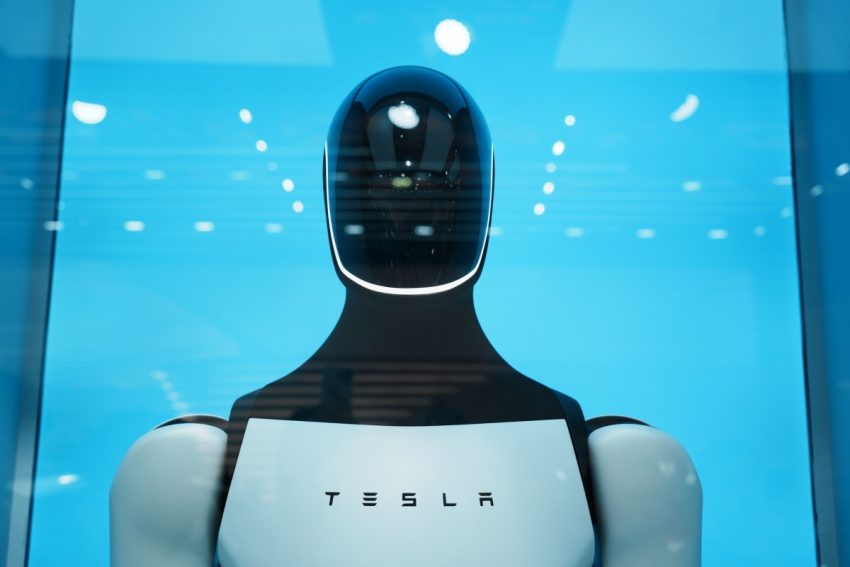
Tesla has started production of its Optimus humanoid robot at its factory in Fremont, California, in a manufacturing space once dedicated to making electric vehicles, the company announced Wednesday.
“The bots coming off this line are the first production-quality bots that we have manufactured,” Tesla wrote in its third-quarter letter to shareholders. “While we will continue to iterate on the hardware and manufacturing process, we have proven that the current manufacturing process for Optimus is suitable for a commercial product.”
Tesla CEO Elon Musk said on a conference call that he considers this “early production,” and that the ramp will be an slow and “somewhat bumpy because it is such a radically new product.” He nonetheless claimed Tesla will be able to make 20,000 of them per week by the end of 2027.
“There’s still some things we need to tweak about the design, because you need to deliver a robot that is that is safe and reliable and has long duration, so it can’t like, wear out after a month,” he said. “And there’s still quite a lot of work to do with regard to the AI and the robot for it to be truly useful for open-ended tasks.”
That fordward-looking development wasn’t enough to lift the company’s otherwise middling third-quarter earnings, results that typify a company at the midpoint of a major bet. Tesla’s revenue was flat and its expenses skyrocketed as it pressed the accelerator on its Optimus robots, AI, and autonomous driving. The end result was a 43% drop in profits.
The company’s revenue was largely driven by EV sales, which were flat year-over-year at $20 billion. Tesla delivered 486,532 vehicles in the third quarter, about 6,000 more than the previous quarter, but fewer than in the same period last year.
Tesla’s total third-quarter revenue was $28.04 billion, a skosh below the $28.09 billion it generated in the third quarter of 2025. Tesla’s third-quarter revenue was also about $200 million lower than the previous quarter’s haul of $28.23 billion.
Tesla saw a 16% year-over-year drop in its solar and energy storage business to $2.8 billion, which it blamed on tariff-related customer refunds. There was some positive revenue growth in its services business, a category that includes customer subscriptions to its Full Self-Driving advanced driver-assistance software. Tesla’s services business grew 33% year-over-year, bringing in $4.6 billion.
None of this was enough to outpace Tesla’s spending on artificial intelligence projects and its Optimus robot, which took a big bite out of profits.
The company reported $787 million in net income, a 43% drop from the same period in 2025 when it earned $1.37 billion. Lower regulatory credit sales also put pressure on its profitability. The company stayed in the black in large part because of a big boost from its “services and other” segment, which accounted for a record $734 million in gross profit for the quarter.
This story has been updated with information from Tesla’s quarterly conference call.
When you purchase through links in our articles, we may earn a small commission. This doesn’t affect our editorial independence.