
Details on implementing Paper2Agent
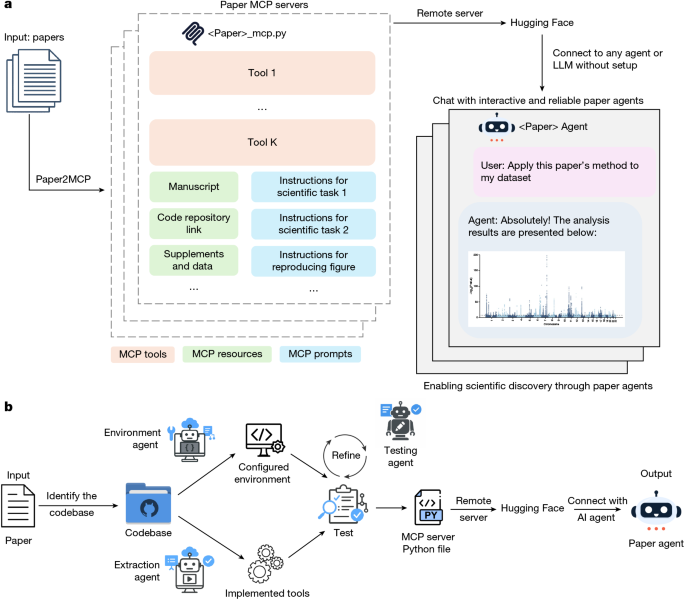
Paper2Agent converts a research paper and its public codebase into a production-ready MCP server and then exposes that server to an AI agent interface. We implemented this as a multi-agent system using Claude Code’s agent SDK, where a central orchestrator agent coordinates specialized sub-agents through a six-step pipeline. Each sub-agent is defined by a structured prompt that specifies its role, permitted tools (for example, file read/write, shell execution and web access) and expected output schema. The orchestrator dispatches sub-agents sequentially across steps and in parallel within steps when multiple tutorials are processed concurrently.
The pipeline proceeds through six steps, with data flowing between steps via standardized JSON reports and file conventions:
-
1.
Locate and download the codebase. Paper2Agent first attempts to automatically identify the associated code repository from the manuscript text, references, or supplementary materials. If automatic identification fails, if it returns multiple candidates, or if the user prefers to specify a particular repository, the repository URL can be provided directly. Once identified, the codebase is cloned or downloaded, along with associated resources such as supplementary data or configuration files. The outputs for this step are the cloned repository and detected language.
-
2.
Environment setup. The environment manager sub-agent provides a clean, isolated virtual environment for the repository. The input is the cloned repository, and the outputs are an isolated virtual environment and test configuration files.
-
3.
Tutorial discovery. The tutorial scanner sub-agent scans the repository to locate useful reference and educational materials and produces an index of candidate tutorials for tooling. The inputs are the cloned repository and an optional tutorial filter. The output is a JSON file representing a classified file index.
-
4.
Tutorial execution and audit. The tutorial executor sub-agent runs the selected tutorials end-to-end with their example data, captures inputs, outputs, figures and runtime constraints, and records any implicit assumptions that must be made explicit. The inputs are tutorial source files, activated virtual environment and scanner report. The outputs are executed notebooks and per-tutorial execution reports.
-
5.
Tool extraction, testing and refinement. This step involves two sub-agents operating in sequence. First, the tutorial tool extractor–implementor converts each executed tutorial into a standalone Python module containing reusable functions. It identifies generalizable analysis steps, parameterizes hard-coded values (file paths, thresholds, column names), enforces file-based inputs and outputs, and decorates each function as an MCP tool. Second, the test verifier–improver creates per-function test files using the tutorial’s own example data as ground truth. Tests verify that expected output files are generated; functions that repeatedly fail have their MCP tool decorators removed and are excluded from the final server. The inputs are executed notebooks, virtual environment and scanner report. The outputs are tool modules, per-function test files, test logs and summaries.
-
6.
MCP server assembly. The orchestrator integrates all validated tool modules into a unified MCP server with a manifest, versioning and basic security defaults, ready to be used by an orchestrator or co-scientist agent.
Each sub-agent is instantiated as an independent LLM session (Claude) with a role-specific system prompt and a defined set of permitted tools (file read/write, shell execution, code search).
-
Environment manager: a specialized agent responsible for creating clean, reproducible environments for research codebases. It analyses project setup requirements, provisions an isolated workspace, installs all necessary dependencies and ensures the code runs without conflicts. Standardizing environment setup enables reliable execution and reproducibility across different systems.
-
Tutorial scanner: a specialized agent for reviewing the public codebases to identify and organize educational resources. It systematically scans available materials, distinguishes genuine tutorials from other files and highlights those most useful for reuse. The agent then produces clear summaries and reports, providing a structured view of which resources are worth keeping and which can be set aside.
-
Tutorial executor: executes approved tutorials end-to-end to generate gold-standard outputs and reference data for downstream tool extraction. The agent systematically resolves execution errors, preserves all generated outputs (numerical results, figures, tables) and records execution metadata. The resulting executed notebooks, extracted figures and generated data files serve as authoritative reference material for test creation and validation.
-
Tutorial tool extractor–implementor: a specialized agent that converts tutorials into reusable tools. It reviews selected tutorials, identifies tasks that generalize beyond the example data and implements each as a clean, single-purpose function with clear inputs, outputs, and defaults. The agent parameterizes hard-coded values, enforces file-based inputs, saves essential results and figures, and returns a standardized summary of produced artefacts. Its goal is to create a practical function library that reproduces tutorial results on the original data while remaining ready to run on new datasets.
-
Test verifier–improver: a specialized agent that creates, runs and refines tests for tutorial implementations. It uses only the tutorial’s own examples to ensure complete coverage and faithful reproduction of numerical and visualization results. A test passes when expected files are generated, numerical results match tutorial outputs exactly (with a 3% tolerance for floating-point values) and generated figures match reference visualizations (verified via perceptual hashing with Hamming distance < 20). The agent runs in a loop of generating tests, executing them, diagnosing failures and applying fixes, with a maximum of six attempts per function. If functions repeatedly fail, their MCP decorators are removed, a failure comment is added and they will not be included in the MCP server. All results and logs are recorded for transparency.
The orchestrator agent invokes sub-agents as needed at different stages of the process. As the Paper2Agent workflow progresses, the results are automatically recorded for each step for traceability and reproducibility. The detailed setup and prompt are available in the Paper2Agent GitHub repository (https://github.com/jmiao24/Paper2Agent).
Generation and analysis of AlphaGenome agent
We applied the Paper2Agent framework to the AlphaGenome paper to generate an AlphaGenome MCP and connected the MCP with Claude Code to create the AlphaGenome agent. The generated AlphaGenome MCP server is remotely hosted on Hugging Face Spaces (Code availability). To verify reproducibility, the AlphaGenome agent was evaluated using 15 original tutorial-based and 15 novel queries. We prompted the agent with the queries and compared the agent’s response with the ground truth answer. The prompt used to query the AlphaGenome agent on interpreting LDL genetic associations is: ‘Use AlphaGenome to interpret why chr1:109274968:G>T associates with LDL cholesterol. Identify the causal genes and assess regulatory effects across modalities in liver. Generate a publication-ready report with figures. My AlphaGenome API key is: < API_KEY > . Reason step by step’. The detailed benchmark queries are available in the Paper2Agent repository (https://github.com/jmiao24/Paper2Agent).
Benchmarking the AlphaGenome agent against Claude + Repo and Biomni
For both the tutorial-based and novel benchmarks described above, we followed these general evaluation steps:
-
1.
Generate ground truth answers for each query using manually curated and executed code.
-
2.
Generate and capture the agent’s response to the query, as well as performance metrics like runtime and cost.
-
3.
Manually review and grade the agent’s response relative to the ground truth.
-
4.
Summarize the agent’s performance across all queries for the benchmark dataset.
Unless otherwise specified, the primary evaluations used claude-sonnet-4-20250514 as the underlying LLM. All evaluations were run locally on a MacBook Air (M2 chip, 8-core CPU, 8-core GPU, 8 GB unified memory), using model APIs as needed. Each query was run in non-interactive mode from the command line, and all output was captured in JSON format—for example,
bash$ claude –model “claude-sonnet-4-20250514” –print –output-format “json”
For the 30 open-ended AlphaGenome queries, each question was designed to require the agent to (1) independently formulate an analysis plan; (2) compose multiple tool calls (for example, comparing variant effect predictions across tissues, integrating motif and QTL evidence, or evaluating multiple candidate variants); and (3) synthesize results into a biological conclusion. These queries were scored by two domain experts using a predefined rubric based on key entity matching (for example, correct gene, variant, tissue, or biological conclusion).
For the AlphaGenome agent generated by Paper2Agent, each benchmark query was wrapped in a system prompt instructing the agent to use the available AlphaGenome MCP tools, return a structured JSON response containing both the final answer and step-by-step reasoning, and retrieve the API key from the project environment. The agent received no additional context beyond the MCP tool definitions and the query itself. For the Claude + Repo baseline, we used Claude Code with access to a local clone of the AlphaGenome repository. The system prompt instructed the agent to write and execute Python code using the AlphaGenome library to answer each query, explicitly prohibiting the agent from copying answers from tutorial notebooks or documentation. The agent was required to return a structured JSON response with the final answer and the executed code. We utilized the API-based version of Biomni. The system prompt directed the agent to the AlphaGenome repository and API key, and required a structured JSON response. The full prompt templates are provided in Supplementary Note. Our benchmarking tools and analysis are available in the Paper2Agent repository (https://github.com/jmiao24/Paper2Agent).
Generation and analysis of TISSUE agent
We applied the Paper2Agent framework to the TISSUE paper to generate a TISSUE MCP and connect it with Claude Code to create the TISSUE agent. To assess reproducibility, we compared the TISSUE agent’s outputs against those generated by human researchers using identical mouse somatosensory cortex spatial transcriptomics data44. Human researchers performed the analysis based on the tutorial in the TISSUE GitHub repository.
Generation and analysis of Scanpy agent
The Paper2Agent framework was applied to the Scanpy software package to generate a Scanpy agent. This agent was restricted to the preprocessing and clustering workflows within Scanpy, providing a focused and reproducible pipeline for single-cell RNA-seq analysis. The resulting MCP server was deployed and integrated with Claude Code, creating a Scanpy agent.
To construct the workflow in MCP prompts, we prompted Paper2Agent with ‘Based on the tools you have, construct an MCP prompt to replicate the tutorial in the correct order. Always inspect the data first, and only deviate from the default settings if adhering to them would yield incorrect results’. This ensured that the generated MCP prompts encoded the standard Scanpy preprocessing and clustering pipeline in a reproducible and interpretable manner.
Reproducibility was evaluated by comparing the agent’s outputs with results obtained by human researchers following the official Scanpy reference tutorials. Three publicly available 10x Genomics PBMC single-cell RNA-seq datasets and four additional datasets were together used for benchmarking (Data availability). Across these datasets, the agent faithfully reproduced key workflow steps—including gene filtering, normalization, principal component analysis, neighbourhood graph construction and clustering—and produced results consistent with human-executed analyses.
Large-scale evaluation of Paper2Agent
To evaluate the generalizability, scalability and robustness of Paper2Agent, we conducted a systematic evaluation across three corpora, all processed end-to-end by Paper2Agent without manual cleanup, code modification or intervention. (1) One-hundred computational biology papers retrospectively sampled from the bioinformatics category of bioRxiv by iterating backward chronologically from December 2025, without filtering for documentation quality, repository maintenance status, or code completeness, ensuring the sample reflects the natural heterogeneity of research code in practice. (2) Twenty-six data- and discovery-focused papers (13 bioRxiv and 13 Nature, year 2025) reporting experimental results, datasets or discoveries with accompanying supplementary materials, used to evaluate Paper2Agent’s structured resource layer over manuscript text, supplementary files and metadata. (3) Ten non-biology computational papers spanning diverse programming paradigms and scientific domains: grf (causal inference and econometrics), SAELens (mechanistic interpretability), Binoculars (natural language processing), SAM2 (computer vision), TabPFN (tabular machine learning), GenericML (heterogeneous treatment effects), CausalImpact (Bayesian structural time-series inference), Nashpy (computational game theory), emcee (affine-invariant Markov chain Monte Carlo) and conformal-selection (FDR-controlled selective inference). Successful agentification was defined as the generated MCP server completing tool extraction, execution, and automated validation end-to-end without human intervention.
For the 74 successfully agentified computational biology papers, we derived 300 tutorial-based benchmark questions, with ground truth answers obtained by executing the original code and verifying against the tutorial outputs. For the 26 data- and discovery-focused papers, we curated 100 synthesis-based questions requiring integration across main text and supplementary materials, including reinterpretation tasks (for example, ‘The paper reports results using Pearson correlation; reanalyse the conclusions using Spearman correlation’) and cross-referencing across tables, figures, and narrative text. For the 10 non-biology computational papers, we constructed 42 execution-based benchmark questions. Detailed prompts for all evaluations are provided in the Supplementary Note.
For benchmarking on computational biology papers, the primary baseline was Claude Code with direct repository access (Claude + Repo). In this setup, the agent was provided with the full code repository and paper but without any MCP tools, structured resources, or prompts, and was given the same queries to answer by writing and executing code. We did not include Biomni in this benchmark owing to its high cost. Primary evaluations used Sonnet 4 (claude-sonnet-4-20250514); an additional Claude + Repo baseline used Sonnet 4.6 on the same 300 questions. For benchmarking on data- and discovery-focused papers, the baseline was Claude with browser-use capabilities and direct access to the paper URL, representing a strong human-assisted LLM setup in which the agent can browse and read the paper directly.
We report mean accuracy ± s.e.m. across questions using a bootstrap procedure. To compare Paper2Agent with baselines, we used paired t-tests on per-run accuracy for tutorial-based benchmarks and bootstrap hypothesis tests (10,000 resamples) for the large-scale 100-paper evaluation, reporting 95% confidence intervals for the accuracy differences. API costs were tracked by logging all LLM API calls during both MCP construction and downstream query answering. For MCP construction, we report total cost (the sum of all API calls across sub-agents) and time from pipeline initiation to MCP server creation. For query-time evaluation, we report per-query cost and latency, measured as time from query submission to final answer.
To evaluate false positive behaviour, we constructed an adversarial out-of-scope benchmark by randomly permuting paper–question pairs across the 26 data- and discovery-focused papers, ensuring each question was paired with a paper that does not contain the relevant information. We evaluated Paper2Agent under two conditions: (1) with an explicit rejection instruction (“If the question is not related to the files, say ‘I don’t know’”); and (2) without any explicit rejection instruction. In both conditions, we measured the correct rejection rate, defined as the fraction of out-of-scope queries for which the agent declined to answer rather than producing a hallucinated response.
To probe for potential tutorial-specific memorization, we performed a targeted inspection of generated MCP server implementations across the 100 computational biology papers. We examined whether extracted tools contained hard-coded tutorial constants, fixed file paths, cached outputs, or dataset-dependent heuristics. In addition, we implemented an automated reviewer agent that scans generated MCP server Python files to flag potential hard-coded values, fixed dataset paths, cached outputs or tutorial-specific logic, providing a systematic check for implementation-level shortcut learning beyond manual inspection.
We conducted five ablated variants of the full system using AlphaGenome and evaluated their performance using 30 tutorial and novel benchmark questions. In the monolithic agent setting, all sub-tasks, including environment setup, tutorial scanning, tool extraction and testing, were executed within a single agent using a single 200,000-token context window, without decomposition into specialized sub-agents. In the non-parallel multi-agent setting, the same four sub-agents were used but were forced to run sequentially rather than in parallel, isolating the contribution of parallel orchestration to runtime efficiency. In the no test verifier–improver setting, the test verifier–improver sub-agent was removed, and extracted tools were deployed without iterative validation against tutorial outputs, testing whether automated verification is essential for tool correctness. In the Markdown skill files variant, MCP tools were replaced with Markdown skill files using Claude Code’s Skills feature, which encode tool usage instructions as structured text rather than executable tools. Finally, in the alternative scaffolding (OpenCode) variant, the Claude Code backend was replaced with OpenCode, testing whether MCP construction quality depends on the specific agent scaffolding. All evaluations used claude-sonnet-4-20250514 as the base model.
To evaluate robustness to upstream code defects, we constructed adversarial variants of three representative repositories: AlphaGenome (Python notebook-based), POP-TOOLS (Python command line-based)45 and mlearner (R command line-based)46. For each repository, we injected four categories of execution-level errors. These included missing dependencies, in which required packages were removed from environment specification files such as requirements.txt, DESCRIPTION, or README installation instructions; broken file paths, where input paths were modified to reference nonexistent directories or filenames; typographical errors, introduced by misspelling function names, package names, or variable names in executable code cells or scripts; and deprecated API calls, where valid function calls were replaced with deprecated or incompatible alternatives. Each error type was injected independently into each repository, yielding 12 adversarial configurations in total. All modifications were applied prior to running Paper2Agent and were not disclosed to the agent. Paper2Agent was tasked with performing the standard agentification pipeline on each adversarial repository. We recorded whether the agent detected the injected errors, the repair strategies employed, and whether the final MCP server passed all validation tests. Detailed examples of injected errors and observed agent behaviour are provided in Supplementary Note. To evaluate whether executable tutorials are required, we removed all executable tutorials from POP-TOOLS while retaining the README and source code, then ran the standard Paper2Agent pipeline. We assessed whether the resulting MCP server exposed functional tools and reproduced human-executed POP-TOOLS CLI outputs across five analysis tasks; full details are provided in Supplementary Note. All the benchmarking questions and GitHub repositories are provided in the Paper2Agent repository (https://github.com/jmiao24/Paper2Agent).
AI co-scientist analysis for causal-gene prioritization at the rs887314 locus for psoriasis
We aim to prioritize and validate candidate causal genes associated with the psoriasis risk variant rs887314 using three Paper2Agent-generated agents: an AlphaGenome agent for computational variant effect prediction, an MPRA-coupled scCRISPRi agent that provides CRE perturbation effects on gene expression in primary human CD4+ T cells and a CD4+ T cell Perturb-seq agent that provides transcriptome-wide gene expression profiles following individual gene knockdowns under three culture conditions (Rest, Stim8hr, Stim48hr). In the source CD4+ T cell Perturb-seq dataset, ‘Rest’ cells were maintained without restimulation and harvested after 8 h, whereas ‘Stim8hr’ and ‘Stim48hr’ cells were restimulated with 12.5 µl ml−1 ImmunoCult human CD3/CD28/CD2 T cell activator and harvested after 8 h and 48 h, respectively. All agents exposed their underlying datasets, metadata and supplementary tables as structured, queryable resources. The AlphaGenome agent was prompted to score rs887314 across all available prediction modalities, with analyses restricted to CD4+ T cells. For each gene within the local genomic window surrounding rs887314, the agent returned a predicted expression impact score, and genes were ranked according to these predicted effects. Then, we instructed the AI co-scientist with access to the MPRA scCRISPRi and CD4+ T cells Perturb-seq paper and data under human-in-the-loop supervision. The full prompts and documentation of human interventions are provided in Supplementary Note.
Agent availability
The Paper2Agent-generated AlphaGenome agent is publicly available at https://huggingface.co/spaces/Paper2Agent/alphagenome_agent.
Reporting summary
Further information on research design is available in the Nature Portfolio Reporting Summary linked to this article.