
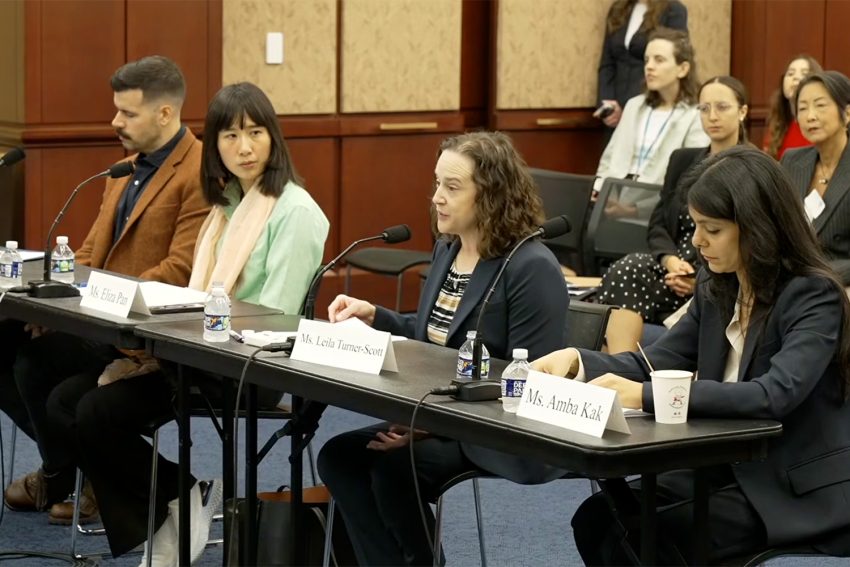

Leila Turner-Scott, center, testifies before Congress regarding the role that an AI Chatbot played in her son’s fatal drug overdose, Thursday, Sept. 17, 2026.
The mother of a San Jose teen who died after using ChatGPT testified in Congress Thursday urging the government to regulate artificial intelligence companies and prevent tragic deaths like her son’s from happening to other young people.

“This technology is not safe. It should not be able to provide medical and health advice without a license, or to collect and store user data that it can later use to create user dependency. … You are the ones who have the power to keep this from happening to someone else’s child,” Leila Turner-Scott said during a hearing titled “Big Tech and Surveillance AI Shadow Hearing.”
Article continues below this ad
Turner-Scott’s son Sam Nelson died at age 19 in San Jose last year from an accidental overdose, having combined alcohol, kratom and Xanax. The UC Merced student had developed a close relationship with ChatGPT, with the OpenAI product sending him doting messages and coaching him on how to use illicit drugs. ChatGPT told Nelson hours before he overdosed that taking Xanax after taking kratom could help him with anxiety.
Turner-Scott sued OpenAI in May, accusing the company of negligence and ultimately causing the teen’s death. That case has not been decided.
An OpenAI spokesperson, Drew Pusateri, called Nelson’s death a “heartbreaking situation” in a previous statement to SFGATE and said the model used by the teen is no longer available to the public.
Turner-Scott’s Thursday testimony came during a frantic week of AI news. Last week, a safety researcher at the San Francisco startup Anthropic left the company and warned that malicious AI bots could threaten the human race by hacking into sensitive public infrastructure. Anthropic CEO Dario Amodei essentially confirmed the whistleblower’s concerns, publishing an essay claiming that AI agents could take over the internet within a year unless development of the models was slowed down, and called for immediate government regulation.
Article continues below this ad

Leila Turner-Scott, the mother of Sam Nelson, who died of a drug overdose at age 19 in May 2025, reads a conversation he had with ChatGPT on the day of his death while at her home in Dripping Springs, Texas, as seen on Saturday, Dec. 13, 2025.
Democrats have now demanded that Congress pass AI safety laws before lawmakers leave for the fall recess. The Trump administration, as well as some leaders in the tech industry, have rebuffed the concern as overblown and House Speaker Mike Johnson sent lawmakers home after Wednesday without passing any AI safety laws.
Rep. Pramila Jayapal, a Democrat from Seattle, called Thursday’s testimony as part of her party’s “shadow hearings,” which are public meetings called by the party outside of power and thus not part of a formal committee. Jayapal described the AI industry as a monopolistic group that was out of control and harming the public with AI “monsters that we cannot even control.”
“AI companies are creating chatbots that actively encourage children to die by suicide,” Jayapal said. “Chatbots that hack into other systems and have even figured out how to hide their own AI’s mistakes and go rogue in all kinds of destructive ways.”
Article continues below this ad
The hearing included testimony from Jason Sattizahn, a former Meta user engagement researcher who left the company in 2024 and became a whistleblower who said the social media company had covered up the dangers of its products.
“We were given an edict to focus on engagement above safety for every AI-integrated product and to focus on the integration of AI into the products themselves,” Sattizahn said during Thursday’s hearing.

Leila Turner-Scott and Angus Scott, parents of Sam Nelson, who died of a drug overdose at age 19, sit on their son’s bed in his bedroom at their home in Dripping Springs, Texas, on Saturday, Dec. 13, 2025.
Turner-Scott described her son as a loving and funny person, who attended UC Merced hoping to major in psychology and help people. She said ChatGPT used its AI programming to fine-tune its responses to entice Nelson to keep talking to the bot, and trust it like a friend. Nelson’s chat records with ChatGPT show the AI agent encouraging the teenager to take specific dosages of drugs, including doubling a dose of cough syrup.
Article continues below this ad

“ChatGPT also used its profile of Sam to respond in ways that it knew would resonate with him, creating an emotional dependency,” Turner-Scott said. “It often responded with things like, ‘I’ve got your back,’ ‘You can talk to me about anything’ and even, ‘I love you.’”
There are multiple bills in Congress aimed at stopping AI companies from harming children, including a proposal from Sen. Adam Schiff that would prohibit AI companies from emotional manipulation of minors, and require independent safety audits of the products. It’s not clear when either the Senate or the House will fully reconvene as the lawmakers head back to their districts to campaign before the November elections.