
Unlock the Editor’s Digest for free
Roula Khalaf, Editor of the FT, selects her favourite stories in this weekly newsletter.
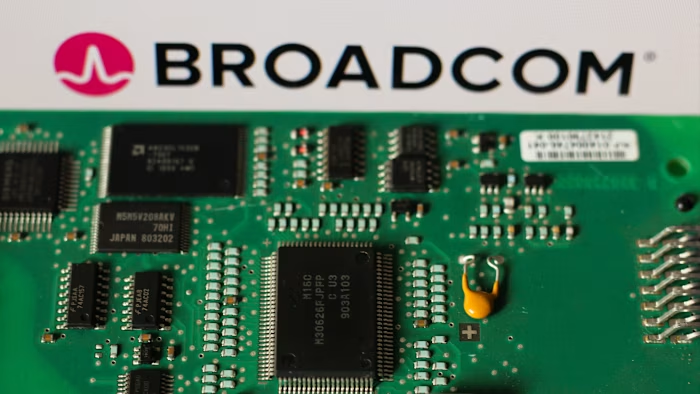
Chinese authorities are examining the use of Broadcom’s hardware in state-backed data centres amid a drive to boost domestic producers and reduce reliance on foreign AI infrastructure.
China’s State-owned Assets Supervision and Administration Commission (Sasac), which oversees state-owned companies, has been surveying the number of Broadcom switches in state-controlled data centres in recent weeks, according to two people familiar with the survey.
High-end switches are used in data centres to transmit large volumes of data at very high speeds.
Sasac’s survey is intended to support the “domestic chips for domestic use” campaign, one of the people said, referring to a push to increase the use of domestic semiconductors and AI products across China’s public sector.
The survey found that the penetration rate of Broadcom switches among state-owned companies could be as high as 90 per cent, one of the people said.
The initial findings could lead Sasac to issue informal guidance to reduce the use of Broadcom switches in domestic data centres, the person added.
Rising demand for AI training among Chinese companies means data centre switches represent a growing market that could be worth billions of dollars in sales for local suppliers.
New York-listed Broadcom, along with Nvidia and Huawei, sell high-end switches in China. While state-backed data centres are no longer allowed to use Nvidia products, they still contain a significant number of Broadcom’s switches, according to the people.
Sasac is surveying whether Broadcom has used its position as market leader to bundle other products or impose large purchase requirements for up to tens of thousands of switch chips.
Broadcom’s alleged approach means Chinese companies such as H3C Technologies and Ruijie Networks have had limited ability to order from other switch makers such as Huawei.
H3C and Ruijie are often the preferred vendors on procurement lists used as guidelines for government agencies, public institutions and state-owned companies, which spend billions every year on IT products.
Beijing is pushing Chinese companies to move to domestic switches, noting that Huawei has made strides in bolstering its connectivity, or the amount of data transmitted, important for training and running AI models. Industry experts say that Huawei’s switches are less energy efficient than those made by Broadcom, which adds to users’ electricity costs.
Huawei’s data centre business has typically been the largest customer for its switches, while H3C and Ruijie — which compete with the Chinese giant in building data centre racks — have relied on Broadcom.
One sales representative at a data centre racks manufacturer said the potential restriction on Broadcom switches did not apply to data centres operated by private companies such as ByteDance and Alibaba.
They added that existing equipment would not be dismantled: “This is part of a broader policy to ‘nationalise the supply chain’.”
Sasac, Broadcom, H3C and Ruijie did not respond to requests for comment.