
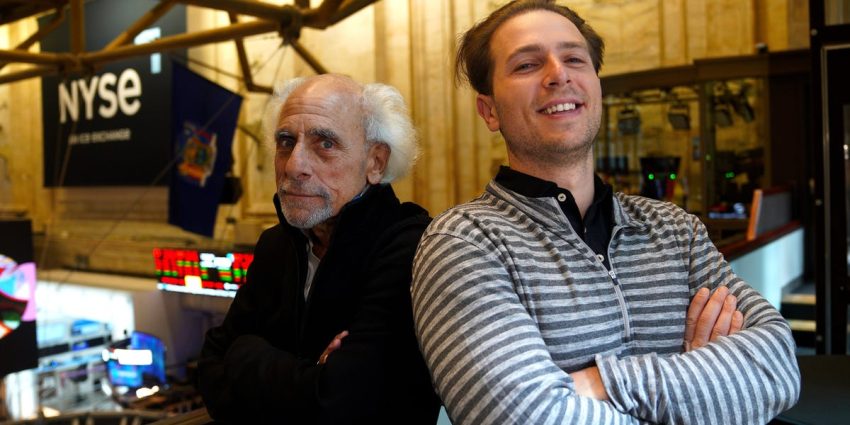
It’s difficult to separate Peter Tuchman from his alter ego.
“The Einstein of Wall Street,” known for his distinctive shock of white hair and animated expressions, says he sleeps for four hours a day and works for 20. Tuchman memorabilia is a common sight at the exchange. Bobbleheads adorn his desk and cartoon stickers of Tuchman riding a bull, the spirit animal of the stock market, are displayed all around his computer.
The most recent addition to the Tuchman collection, however, is much more impressive. MARKET SAVANT is a life-size bronze sculpture of Tuchman recently commissioned by the NYSE in celebration of the veteran stock broker, his team tells me.
Tuchman has been a market celebrity for years, but lately, the TradeMas broker has been using his renown for a distinct purpose: advocating for the human trader in the era of AI.
Wall Street was in the throes of a tech overhaul before the advent of artificial intelligence, with digital brokerages largely eliminating the need for traders to be present on the floor of the stock exchange. AI has intensified job displacement anxiety for those who remain in the industry, given that the tech is already doing much of the scutwork that has long defined junior and back-end roles on Wall Street.
Most finance leaders say investing in AI will maintain or possibly increase headcount this year. Still, 28% predicted AI would lead to headcounts dropping this year, per EY’s survey of financial CEOs.
The number of brokers and clerks packed onto the floors of the NYSE once peaked at over 3,000 before dwindling to around 1,700 in 2007, the New York Times reported at the time. The NYSE did not provide an estimate of the number of people currently employed on the trading floor.
Mateo Mantilla/Courtesy of Peter Tuchman
Benny Tuchman, Peter Tuchman’s son and a broker at the exchange, says the two have become the NYSE’s loudest advocates for preserving human labor, often making the case that it fosters trust in clients if a real person is involved in a transaction.
The vast majority of stock trades today are executed digitally, though human brokers still help with larger and more complex orders from institutions.
Tuchman’s role has evolved into campaigning for the role of the human trader. Tuchman says he often works from dinner to bedtime and rarely goes out. When he was in the hospital recently, his team took away his cell phone to prevent him from posting while recovering, his son says.
“I’ve sort of taken it upon myself along with the powers that be in my world and in this ecosystem to try and preserve the human element in the marketplace,” Tuchman told Business Insider in an interview, outlining his career ambitions for his son. “I’m setting the stage for my son to have a really good legacy.”
“We’re some of the few people that are actually speaking up to hopefully thwart any technological advancements down here that would otherwise, in our eyes, render us useless at a certain point,” Benny said.
The market savant
Michael M. Santiago/Getty Images
Over the years, Tuchman has morphed into a mascot for the NYSE. He assumed the title of the exchange’s most-photographed trader when Allan Gershowitz, the famously well-photographed trader at the stock exchange dubbed by Fortune Magazine as “Market Dude,” retired in 2007.
Tuchman says his big breakout came the very next day, when a photo of him with a frenzied expression and his hands raised in the air after a big sell-off landed on the front page of the New York Daily News.
“He said, ‘You know what, Peter? I’m handing you the gauntlet. I’m no longer the Market Dude. I’m retiring. You can be the guy they take pictures of,'” Tuchman recalled.
Tuchman, who says he’s been 55 years old for the last 12 years, said he’s been aware of the technological shift away from human brokers since the turn of the century, when he first began to incorporate tech into his daily responsibilities. The trading floor started to get quieter, a shift from when Tuchman first joined as a teletypist in 1985, when the exchange functioned as an auction market and brokers yelled across the room to fill stock orders.
In 2018, Tuchman made what he describes as a hard pivot to growing his social media and television appearances. During the pandemic, he also launched a trading education business with the former NYSE trader David Green, capitalizing on the massive burst of attention on day trading and earning a living in markets during the pandemic stock boom.
“The whole nature of Wall Street sort of changed a little bit. And so I saw the writing on the wall,” he said.
It coincided with a painful period in Tuchman’s personal life. His career pivot took place a year after his brother passed away in 2017 and several years before his wife died in 2023. Tuchman says his work and his colleagues at the NYSE, whom he calls his family, helped keep him alive.
“It’s really not about me,” he said of his market celebrity. “It’s about the broker. It’s about the family,”
Tuchman and his son admit they aren’t sure what the future will hold or whether AI will lead to fewer brokers working at the exchange.
“On my worst day, I’m an execution monkey for the most part,” Benny said. “But if that were the case, we would know that we left kicking and screaming on our way out.”
Tuchman says he has no plans to retire anytime soon.
“Absolutely not. I’m having too much fun,” he said.