
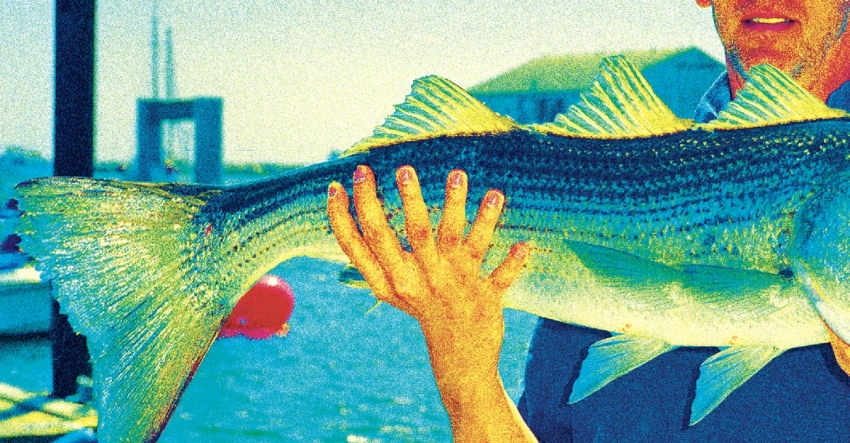
Earlier this year, one of my fishing partners sent a 1 a.m. message to our group chat. It was a link to an Instagram post of an angler holding a sizable striped bass. Dappled gold and silver with a dozen distinct black lines that stretched from gills to tail, it would have been a gorgeous fish if not for two problems: Striped bass usually have seven stripes, not 12, and men usually have five fingers, not six. The photo, it seemed, was AI-generated. To say we were dismayed would be an understatement.
From May to November each year, I spend most of my nights doing an extreme version of surf fishing for striped bass called “wetsuiting,” which involves wading or swimming out to distant ocean rocks and sandbars after dark. This kind of surf casting is a niche activity, and like many niche activities, the community for it is small. Wetsuiters can be found in a smattering of local fishing clubs throughout the Northeast—the typical range of the striped bass—but are primarily connected through Instagram, where some people, mostly for bragging rights, post images of fish they’ve caught.
In our group chat, my fishing partners and I spend too much time scrutinizing photos of bass that other anglers have posted. People who fish are habitual liars (I say this fondly), and most of our conversations take the form of debates about whether a fish is really as big as someone claims. Lately, though, we’ve been asking a different question: Is that fish even real?
In recent months, the small corner of Fishing Instagram devoted to surf casting has been plagued by a slow drip of AI-generated or AI-enhanced fish. Sometimes, the fraud is egregious—one of my friends, a fishing photographer, discovered that another angler had stolen one of his photos and crudely replaced my friend’s face with her own. More often, the distortions are subtle. Typically, a fish or fisherman looks ever so slightly off, usually in ways that a casual observer might not notice: A bass’s fins aren’t quite right, or the lure in its mouth looks oddly distorted, or the angler’s arms are a bit too long. In my favorite example, a man lifts a large striped bass just as he is getting pummeled by a wave. The scene looks daunting—until you realize that the ocean behind him is peaceful. Where did this rogue wave come from? One suspects that the enterprising angler, wanting to look more hard-core to his Instagram followers, prompted a bot to dial up the intensity. ChatGPT, make me look badass.
Fishing magazines report growing concern about AI-generated fish in freelance photo submissions. I have written occasionally for the small online magazine Surfcaster’s Journal. Over the summer, the Journal announced that it would now run all manuscripts and photographs through AI-detection software. “For some reason, I naively assumed that fishermen wouldn’t stoop to the ‘core of the earth’ lows required to use AI to prop oneself up as a fisherman worthy of clicking the follow icon,” Dave Anderson, a well-respected wetsuiter and an editor at The Fisherman, wrote in an article lamenting the scourge of artificially generated fish on social media. “I was very wrong about this.”
Angling, even extreme angling, is just a hobby, but although the stakes may be low, the anger about artificial fish is real. Partly, I think this is because of the work that being even remotely good at the sport demands. Striped bass move and feed in locally specific patterns that can take months or years to crack. There is a risk of drowning, and the mounting reports of bull sharks, tiger sharks, and great whites in the Northeast call attention to another layer of danger: We smell like fish, swim in dark water, and look like clumsy seals in our black neoprene. Wetsuiting does not change the world, but it is an activity that is hard and honest and, in that way, human.
Even taking a picture of a fish is demanding, requiring salt-water-proof cameras and often wading or swimming a bass back to shallow water, where it can safely be photographed and then released. The Photoshopping of fish pictures—and of the natural world in general—has been an issue for years, but AI, with its ability to conjure a simulacrum of reality out of nothing at all, is another matter. It automates away the need not only to photograph a fish, but to even catch one in the first place.
The problem extends to other sports and hobbies, many of which are now defined by what Stuart Franklin—who took one of the celebrated “Tank Man” photos at Tiananmen Square—calls the “documentary impulse.” Social media has turbo-charged that impulse into an imperative. A good local skateboarder’s or surfer’s reputation would once have been built through word of mouth. Today, posted photographs and short-form videos may constitute the primary proof of ability. Concerns about AI slop are already being raised in cycling, skiing, and other activities. Climbing Magazine recently called out an AI-saturated YouTube channel purporting to chronicle climbing disasters that in fact never happened.
As AI-generated fish have appeared more frequently in my social-media feed, I’ve been reminded of a scene in the bird-watching documentary Listers, where a highly competitive birder is asked whether he would keep bird-watching if the photo-logging website eBird disappeared. His answer—“No”—was unsettling, not least because one suspects that this sentiment is widespread in hobbies besides birding. I have often wondered if, for some of the wetsuiters who populate surf-casting Instagram, the dopamine hit from the likes and fire emoji is sweeter than the hit from catching the fish itself. Now that posted images are being looked upon with an ever greater degree of suspicion, I also wonder how much longer the dopamine hits will come for them at all.
This is hardly the greatest challenge posed to humanity by the advent of AI. But hobbies, particularly those that require some measure of skill and endurance, have an influence that extends beyond those who directly participate in them. Free Solo, the Oscar-winning 2018 documentary about the death-defying rock climber Alex Honnold, found a wide audience outside the narrow world of climbing because people are invested in seeing other people do difficult things. I love videos of big-wave surfing even though I never plan to climb onto a surfboard. If AI makes it impossible to trust what we see, even something as simple as a surfing video, then we have lost more than the integrity of any one sport. We have lost the ability to believe in the accomplishments of others.
This article appears in the November 2026 print edition with the headline “The Fish Are Getting Bigger.”