
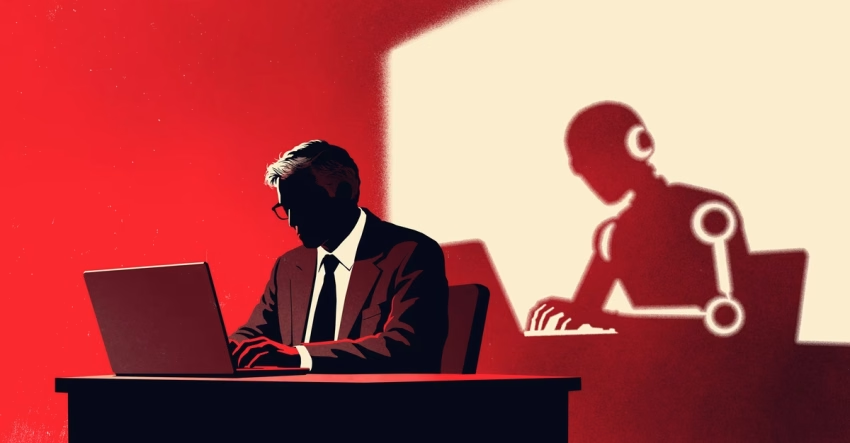
The university where the term artificial intelligence was coined is ringing in the field’s 70th birthday in fitting fashion: with an academic-integrity scandal. Last month, Dartmouth College’s president, Sian Leah Beilock, published an essay in The Atlantic headlined: “Why I Want More AI at Dartmouth.” Now Beilock is launching a review of whether her top deputy used too much AI.
On September 21, the student newspaper The Dartmouth reported that Provost Santiago Schnell appeared to have relied heavily on AI to write all nine of the articles he’s published this year—including a Washington Post op-ed about students outsourcing their writing to AI. Schnell’s response to the accusation didn’t help his cause. According to the student paper, he sent an email statement acknowledging that he uses AI chatbots as “assistive tools” in his writing but downplayed their role in his process. Even Schnell’s statement, the paper found, registered as “100% AI-written” on Pangram, an AI-detection service that is imperfect but boasts a very low error rate. A Dartmouth spokesperson told me that neither Beilock nor Schnell would comment for this story.
Schnell is the latest example of an ironic phenomenon: People whose job involves writing about the appropriate uses of AI—or even setting the rules on AI use for others—keep getting caught using AI to do it. There was the Australian university professor whose op-ed about the importance of students doing their own writing turned out to be at least partly AI-generated. There was the nonprofit executive whose book about the future of truth in the AI age turned out to include quotes fabricated by AI. There was the AI beat reporter who reportedly lost his job after he accidentally copied quotes invented by AI into one of his stories. And there was the Stanford misinformation expert who got upbraided by a judge when his declaration supporting an anti-AI-deepfake law turned out to contain ChatGPT-hallucinated citations.
It’s one thing to embrace AI writing openly or shamelessly, like the billionaire financier who readily acknowledged the technology’s role in his Wall Street Journal op-ed (albeit only after it was discovered). It’s another to use AI to inveigh against improper uses of AI, and it raises an awkward question: Why do some of the people warning us most loudly about the technology’s pitfalls keep tumbling headfirst into them?
I reached out to all five of the individuals listed above for an answer, but the only one who agreed to speak with me on the record was Steven Rosenbaum, the author of the book The Future of Truth: How AI Reshapes Reality and the executive director of the nonprofit Sustainable Media Center. Unlike some of the others, Rosenbaum disclosed his use of AI in the writing and editing process, and he has never tried to tell other people not to use it. But that didn’t save him from ignominy when The New York Times reported in May that the book was riddled with AI-generated misquotes. I spoke with him at the time, and he told me that he felt “betrayed” by ChatGPT. Five months on, Rosenbaum seems to have accepted a bit more responsibility for the mistakes. He told me that he is preparing to publish a revised version of his book with all of the errors corrected, an author’s note, and a new chapter on (what else?) AI hallucinations. He still believes that the fault lies more with the technology’s makers than its users, though. “As a technology, it is incredibly seductive,” he said.
Rosenbaum said that he’d started out using AI to better understand the technology. He’d gradually come to rely on it as a writing partner that made the work both easier and less lonely. He described his experience of writing with AI as a messy process, one in which the work of the human and that of the machine get all tangled up. “The line between thinking and researching and reading and outlining and drafting and writing is really blurry,” he said.
A simple solution, of course, would be not to use AI at all. Rosenbaum, however, has no interest in that. He said that he still plans to use chatbots as a writing companion—just “more carefully” now, double-checking all of their claims and citations before adopting them. He’s not alone in his unwillingness to abandon the tools that got him in trouble. Although each of the people caught using AI to warn about AI has commented publicly on the episode in some form, none responded by swearing off the technology. Rosenbaum, for his part, thinks we’re headed toward a world in which writing with AI is the norm and all that matters is the result. “I don’t think readers care how the sausage is made,” he said. “They care that it’s delicious.”
I’m not so sure. I too have experimented with using AI as a research tool in my writing. But The Atlantic has a strict policy against the use of AI-generated prose, and so do I. I’ve found that having a personal red line is both useful and clarifying: I might ask a chatbot questions, get its feedback on a word choice or an explanation, or ask it to poke holes in my argument, but I will not ask it to write for me or use its writing in my own drafts. I think readers value knowing that every word they’re reading was chosen by the author and not an algorithm. That said, I can see how the distinction between using AI for research and writing could feel slippery to some. It’s conceivable, for instance, that a chatbot’s biases could be infiltrating my ideas, if not my precise words. (Then again, so could the biases of Google’s search-ranking engine or my social-media feeds.)
I have another theory as to why people who caution others about AI seem to be using it themselves. In a scenario strikingly similar to the one at Dartmouth, the professor in charge of academic integrity at Western Sydney University wrote an op-ed in May on the importance of students not delegating their work to AI. “Don’t cut corners,” Cath Ellis, the university’s pro-vice-chancellor for quality and integrity, wrote in The Sydney Morning Herald. “Don’t outsource your thinking, however tempting that may be.” The op-ed, it soon became clear, had been generated at least partly by AI. In that case, a university spokesperson defended Ellis’s use of the technology as “sophisticated and appropriate,” because she had fed her own past work into the AI tool before asking it to help her draft the op-ed. Ellis told The Sydney Morning Herald that the op-ed hadn’t been written “by” AI: “It was written with AI, and there’s a really big difference there,” she said.
Ellis’s excuse might ring hollow to the students she chastised, but it’s revealing to those of us trying to wrap our minds around the apparent hypocrisy. In her op-ed, Ellis implied that students who use AI to write are outsourcing their thinking. In defending her own AI use, she distinguished between the writing (which she outsourced) and the ideas (which she claimed were original). Likewise, Schnell fretted in his op-ed that “students can now produce proficient prose without performing much of the intellectual work the prose appears to represent.” Yet when confronted with his own AI use, he claimed authorship of the “ideas and arguments” even if bots did some of the writing.
These guardians of academic integrity might be right that what they did is meaningfully different from a student simply feeding a professor’s assignment into a chatbot and handing in whatever it spits out. Of course, students can use AI in more nuanced ways too. No doubt plenty of students accused of AI cheating have mounted defenses that sounded a lot like Ellis’s and Schnell’s.
Writing is thinking has become a common refrain among critics of those who use AI tools to do their writing. What we see again and again in defenses of AI writing is that the people using AI don’t seem to apply that maxim to themselves. And experts on the perils of AI fakery such as Rosenbaum and the Stanford misinformation expert, Jeff Hancock, appeared to have overestimated their own ability to steer clear of AI falsehoods. It’s reminiscent of what the sociologist W. Phillips Davison called the “third-person effect” in mass media: people’s tendency to believe that they’re immune to persuasive messaging even as they expect it to influence others.
It is a form of hypocrisy, and it’s hard to feel much sympathy for thought leaders who get caught practicing what they preach against. But the fact that even professed AI experts blunder into overrelying on the technology suggests that Rosenbaum is onto something: Chatbots might come with fine-print disclaimers that they can make mistakes, but they bend over backwards in their interactions with users to come across as honest and trustworthy. It’s also true that society has yet to develop a vocabulary for all the ways of writing with AI that fall in between “AI-generated” and “entirely human-written.”
Here’s where I acknowledge that even my own bright line on AI use might be fuzzier than I realize. In the process of writing this story, I described the thrust of my argument to Google and Claude and asked them for examples of AI-writing hypocrisy that I may have missed. Neither managed to surface any that I hadn’t previously been aware of. On a whim, I followed up with Claude by asking it to brainstorm some hypotheses as to why AI skeptics might fail to heed their own advice.
I had my own ideas, and I had also solicited the thoughts of colleagues, but I wanted to see what the chatbot would come up with. One of its suggestions struck me as a sharper version of a thought I’d been struggling to formulate: “Writing is thinking is a rule for other people,” it mused. I didn’t use Claude’s language, but the AI model had crisply summarized a notion I’d been thinking over. That formulation no doubt informed how I thought about this story’s framing. Am I an AI-writing hypocrite now too?
I talked through some of this with a journalist who once got in trouble over a story that contained AI-generated errors. We corresponded on the condition of anonymity because they said that resurfacing the incident could damage their job prospects. This was the lesson they said they had learned: “AI is a power tool, and like any power tool it’s dangerous if you’re careless with it. You can be the guy who warned everyone that a table saw can cut your fingers off and still lose a finger one day, because that risk is built into the machine. It goes up the more you use it.”
When you think about it that way, it makes sense that some of the people relying on AI would be the same ones sounding the alarm about its risks. They know its flaws, but they also know its power. And they just can’t bring themselves to give that up.