
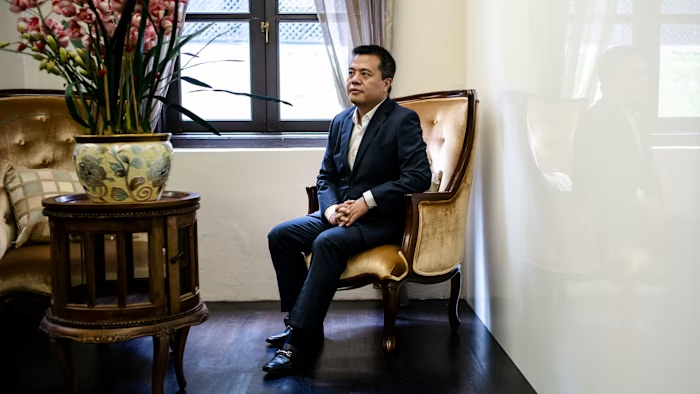
Chen Tianqiao launched California-based AI start-up MiroMind last year, drawing on teams in Singapore, Beijing and Shanghai to develop a deep research agent.
But within months, the cross-border model began to unravel. After Beijing opened a review in January of Meta’s acquisition of Manus, a Chinese-founded AI start-up that had relocated to Singapore, over potential breaches of export controls, Chen shut MiroMind’s China operation and cut its researchers off from the company’s overseas code and data. He has since rebuilt its AI research operations in the US and Singapore.
Chen’s experience highlights the challenges facing technology start-ups seeking to combine Chinese engineering talent with US capital and markets as geopolitical tensions and tightening regulations make the model difficult to sustain.
“You can no longer benefit from both systems without bearing the obligations that come with each,” said Chen Qiheng, a non-resident fellow at the Asia Society Policy Institute.
The Chinese billionaire’s foray into AI marks his second entrepreneurial venture, more than two decades after founding Shanda, the online gaming company whose Nasdaq listing in 2004 made him China’s wealthiest person.
He later reinvented himself as a global investor, with holdings including leading technology companies and a timber portfolio in Oregon, after relocating to Singapore in 2010 and then California in 2017. He has also donated hundreds of millions of dollars to neuroscience research worldwide.
ChatGPT’s rapid adoption in 2023 convinced him that AI represented the “greatest discovery in human history” and offered him the chance to build a business again, Chen told the FT.
He began by launching a few AI application companies before founding MiroMind, a California-based start-up developing foundation models for scientific and industrial applications, in April 2025.
Chen hired Dai Jifeng, a Tsinghua University professor and a prominent AI scientist, to assemble a research team in China to work alongside another in Singapore.
Within months, MiroMind launched an open-source agent specialised in deep research capable of tackling complex tasks such as estimating the likelihood of Federal Reserve rate cuts. Successive versions achieved leading scores on benchmarks including BrowseComp, which tests an AI agent’s ability to locate difficult-to-find information online.
But conditions shifted in January, when Beijing launched an investigation into Manus’s more-than-$2bn sale to Meta, scrutinising whether technology developed by a Chinese-founded company remained subject to China’s export control even after it had relocated overseas. Beijing later called off the transaction.
The intervention alarmed Chen, as MiroMind relied on a similar cross-border model, with China-based researchers working with teams abroad. On January 16, MiroMind shut down its Beijing and Shanghai operations, a move Chen said was intended to create a “firewall” separating the company’s overseas operations from China.
“The regulatory environment between the US and China had become much more sensitive, so we decided to be extra cautious and cut everything off,” he said.
Chinese authorities also contacted MiroMind following the Manus episode, as officials sought information from AI companies about potential technology transfers, according to people with knowledge of the matter. Chen told officials that MiroMind was incorporated in the US and differed from Manus.
Although Dai had obtained an O-1 visa, which allows foreigners with extraordinary skills to work in the US, through MiroMind, he ultimately remained in China and founded his own AI start-up, joined by several core members of the Beijing team.
The split later escalated into a public dispute. Dai accused Chen of seeking to move technology and personnel from China to the US. Chen, in turn, alleged Dai had abandoned an agreed relocation to the US and used MiroMind’s code and employees to establish a new company.
“I was once very willing to bring talents from across the world to work in the US,” Chen said. “I was very disappointed about the incident and won’t hire large language model researchers in China going forward.”
Dai declined to comment.
As MiroMind wound down its Beijing operation, Chen shifted his recruiting focus to the US, poaching top AI researchers from industry leaders such as Meta and xAI.
Yet even lavish pay has not guaranteed hiring success for a company with limited name recognition in Silicon Valley. Chen said one candidate this year turned down an offer worth $100mn in cash and stock annually.
“Money is not the only consideration for candidates at that level,” he said. “Anyone competing with us is almost certainly offering compensation on the same scale.”
Chen argued the company’s biggest draw was the opportunity to help build a large language model from the ground up — an experience researchers are unlikely to get at more established AI companies.
He said he had invested about $2bn of his own capital across his AI ventures and was prepared to commit another $2bn if external funding did not materialise.
On the product front, Chen has shifted his focus from MiroMind to Apodex, a “heavy-duty solver” AI agent aimed at research-intensive scientific tasks such as drug discovery and gene therapy delivery system design.
He has set ambitious targets for the new product, which launched in June, saying he hopes it will generate $1bn in contracted revenue by next June and become an industry-leading AI product by the end of next year. He added the company aimed to break even by June 2027 and go public by the end of that year.
“I spent three years taking my gaming company public on Nasdaq,” Chen said. “There is no reason I can’t turn a profit in three years this time.”
Alvin Graylin, a fellow at Stanford Digital Economy Lab, said Chen faced “a tough uphill battle” as a newcomer in an already highly competitive market.
Graylin added that Chen’s Chinese citizenship might also put him under scrutiny amid the US-China rivalry. “If somebody wants to throw shade on him, they just need to say, ‘Look, he’s a Chinese billionaire,’ and instantly people may say, ‘I don’t know if I want my data to go there.’”
Chen, however, believes there remains space for Chinese AI entrepreneurs to operate in the US.
“As long as there is room, an entrepreneur’s job is to create value within the constraints that are given,” he added.