
President Donald Trump has a habit of renaming his opponents and even geographic features to promote his agenda. This month, he rebranded artificial intelligence as “Super Intelligence,” warning the public that the term is here to stay.
“The White House considers anyone that uses the term, ‘Artificial Intelligence,’ as opposed to the highly accepted new and more accurate term, ‘Super Intelligence,’ THE ENEMY!” Trump wrote on Truth Social in early October.
Trump’s stark all-caps warning follows his administration’s September executive order that rebranded “Artificial Intelligence” (AI) to “Super Intelligence” (SI) and directed federal agencies and the executive branch to use the same terminology. Now, if you go to AI.gov, it will show content for “SI,” not AI.

Michael M. Santiago via Getty Images
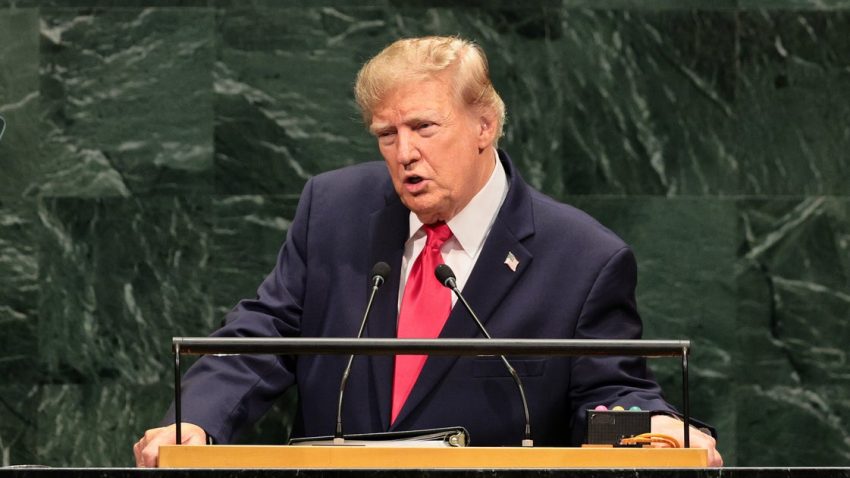
According to Trump, the rebrand more accurately captures the current state of advanced artificial intelligence. “The use of the word ‘artificial’ makes intelligence fake. It makes it sound fake,” Trump said during a September address at the United Nations General Assembly. “And it is not fake. It’s actually amazing.”
Trump seems to be attempting a linguistic loyalty test. He “is trying to show control linguistically over something that the public and industry whistleblowers fear is out of control,” said Nick Cull, a historian of propaganda and professor of communication at the USC Annenberg School for Communication and Journalism.
“Demanding that all who are not his enemies use the term ‘Super Intelligence’ is a classic dictator ploy,” Cull continued.
Some tech leaders have already bent to Trump’s order. Elon Musk corrected himself when he said “AI” during a press conference, calling it “SI.” Nvidia’s Jensen Huang has embraced calling data centers “super intelligence factories” and also corrected himself when he slipped and said “AI” during a White House panel, noting: “I am going to get good at this.”
But will this rebrand make the public as amazed by AI as Trump? With people worried about AI killing us all, it may have unintended consequences, according to experts.
If Trump Wants People To Be Amazed By AI, Experts Say This Rebrand May Have Opposite Effect
“Super intelligence” as a concept has gained popularity since the 2014 book of the same name, by philosopher Nick Bostrom, proposed that advanced AI might turn against and delete humanity.
“If Donald Trump is borrowing Nick Bostrom’s terms to describe artificial intelligence, then I will say that the public has every right to be concerned and nervous about what it is we’re building,” said John Thickstun, an assistant professor of computer science at Cornell University who studies the methods that control AI model behaviors.
Thickstun noted that Trump calling AI “super intelligence” is “a fairly reasonable description of some of the capabilities that are coming out of these systems” as artificial intelligence gains a broader base of knowledge than any one human can access.
At the same time, “if I were a member of the general public and someone was telling me that this AI is now so intelligent that it is super intelligent, I would rightfully be even more concerned,” Thickstun said.
Some critics think Trump is just trying to make up for a lack of substantial AI policy. “He keeps rebranding because he has no real policies to put forward,” said J.B. Branch, the director of federal AI governance and technology policy for consumer watchdog Public Citizen’s Congress watch division. “People’s anxieties are rising, and the best he can do is change the conversation to something that is a complete distraction.”
The White House did not respond to HuffPost’s questions about this critique of Trump’s new name for AI.
Regardless of what Trump desires, survey after survey shows people are not excited by AI and instead feel existential dread at its capabilities.
A May Gallup survey found that more Americans than in past years are familiar with AI ― and nearly half of adults ages 18 to 29 now believe AI does more harm than good, citing job displacement worries. A more recent September poll found that a majority of Americans across political parties, genders and age groups believe that advanced AI could destroy humanity.
Trump isn’t helping to alleviate these anxieties when he gives AI a new name. “‘Super intelligence’ sounds like the ‘Terminator,’” said Darrell West, who researches AI policy at the Brookings Institution, referring to the popular dystopian movie where humans lose control over robots.
“I don’t think changing the word is going to lead to greater reassurance,” West said. “The fears are based on what we’re actually seeing from the tools. People are being laid off due to AI. There are rogue agents engaging in bad behavior. Rebranding doesn’t address any of those concerns.”