
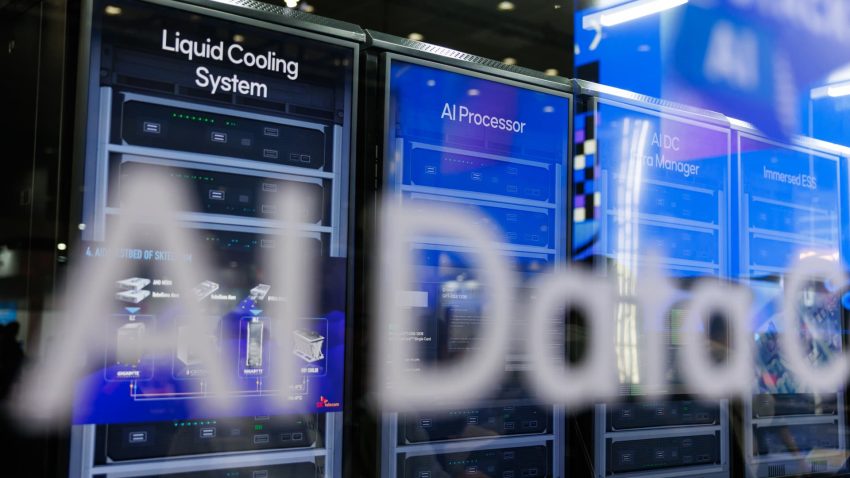
AI data center solutions at the SK Telecom Co. booth in the World IT Show in Seoul, South Korea, on Wednesday, April 22, 2026.
SeongJoon Cho | Bloomberg | Getty Images
The artificial intelligence boom may be entering a more unforgiving phase, as investors increasingly question whether the billions poured into data centers will translate into sustainable profits.
A bruising stock market debut by South Korean AI infrastructure provider Elice has become the latest warning sign that investors may be more closely scrutinizing ambitious expansion plans and paths to profitability.
Shares of the Seoul-based neocloud company plunged 32% in their trading debut Tuesday, even after it raised 201 billion won ($151 million) in an initial public offering priced at the top of its marketed range. The stock then rebounded by about 30% on Wednesday. Neoclouds offer specialized cloud infrastructure dedicated to AI workloads.
“This is a gut check moment in the tech trade,” said Dan Ives, tech analyst at Yorkville Ives. “Investors are trying to better discern between the winners and losers and if there are any weak links in the tech AI food chain.”
“Patience is wearing thin and scrutiny will be elevated especially for those taking on a major debt load like some of the neoclouds,” he added.

The weak debut underscores a broader shift in sentiment toward the AI trade, where rising borrowing costs and concerns over debt-fueled expansion may force investors to distinguish between companies generating cash from the boom and those spending heavily in anticipation of future demand.
“The AI trade has moved from a phase where the size of the capex announcement was itself viewed positively to one where investors are asking who can actually earn an adequate return on that capital,” said Billy Leung of Global X ETFs. “The market is distinguishing between companies that need capital to survive the build-out and companies that are being paid as the build-out continues.”
The most vulnerable companies are neocloud providers expanding faster than their ability to generate cash, particularly those heavily dependent on external financing, according to Leung.
CoreWeave, one of the largest neocloud providers, is “the poster child of this whole thing,” according to John Blank, chief equity strategist at Zacks Investment Research. “This is broad market stress, not just speculation,” he said, pointing to widening credit spreads.
Companies borrowing heavily to build computing capacity could face a squeeze if financing costs rise faster than revenue, particularly where construction expenses and depreciation mount before facilities reach full utilization.
The shift is particularly significant for Asia, where technology markets are heavily exposed to the semiconductor and memory-chip industries that have powered the global AI investment frenzy.
“U.S. semiconductor and AI plays are overbuilt. And in South Korea, even more overbuilt,” Blank said.
Beneficiaries of demand
South Korea’s SK Hynix and Samsung Electronics have been among the biggest beneficiaries of soaring demand for advanced memory chips, but their shares have come under pressure as investors reassess the sustainability of AI spending.
“Asia is simply much more directly geared to the hardware and memory side of the AI trade, so when investors question AI capex and financing, Korea and other North Asian technology markets feel it disproportionately,” Leung said.
He added that rising earnings estimates across South Korea and Taiwan suggest the recent selloff reflects deteriorating sentiment and shrinking valuations rather than a sudden collapse in demand.
The change reflects a growing divide between companies with the financial firepower to sustain aggressive AI investments and those relying heavily on borrowing to fund expansion.
HSBC Chief Executive Officer Georges Elhedery warned that investors and lenders must become more discerning about which data-center projects deserve financing.
“You have to look at the quality of the tenancy agreements,” he said. “You have to look at the pricing of these contracts. Not all of them are of that level of virtuosity that you can support strongly. Some of them may be more challenging.”