
Stay informed with free updates
Simply sign up to the Artificial intelligence myFT Digest — delivered directly to your inbox.
The writer is Simonyi professor for the public understanding of science and professor of mathematics at the University of Oxford
Three months ago I tried using OpenAI’s ChatGPT to assist me in my mathematical research to discover non-polynomial behaviour in the zeta functions of free nilpotent groups. It was useless. All it did was regurgitate statements in papers that I’d already published.
Two weeks ago I decided to try again. The result was phenomenal. I suddenly had an insightful collaborator that knew how to code and do experiments in the structures I was investigating. It made mistakes but corrected them often on reflection. It responded to my new ideas and suggested its own. It reached a level of understanding of the issues involved that frankly would have taken a new student embarking on their PhD months to grasp. Using ChatGPT, I have now discovered very plausible evidence of the behaviour I conjectured.
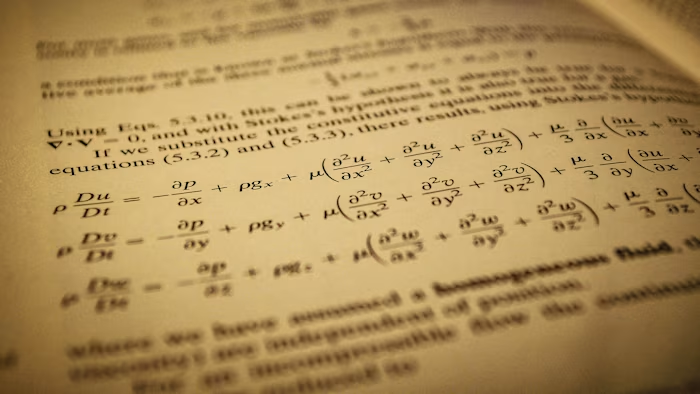
Because of this experiment, I was not altogether surprised by OpenAI’s recent announcement of its AI model’s successful progress on the Navier-Stokes equation — one of the seven unsolved maths problems known as the Millennium Prize Problems.
I had already witnessed the extraordinary progress these large language models have made in navigating mathematical ideas. They seem particularly adept at the types of mathematical challenges exploring possible anomalous behaviour in structures. The progress in the Navier-Stokes equation, for example, was the identification of a setting where a model fluid blows up in finite time without requiring infinite energy.
As well as being especially good at finding counterexamples, I am beginning to see evidence that AI can even build robust proofs of theorems. I think that in the past few weeks we have seen a phase change in the abilities of AI — one that prompted me to sign a letter from the mathematicians who are fellows of the Royal Society asking the president to communicate to the government that we are in the throes of an AI emergency.
We believe the recent developments have profound implications for mathematics but the systems are likely to be comparably strong in other technical domains, including cyber security, autonomous weapons, biological and chemical agent development and the spread of misinformation.
I have previously compared the arrival of these new AI tools to the moment Galileo picked up a telescope for the first time and was able to see things in our solar system that we’d never seen before. It is an exciting and transformative moment to be doing science. But it is also a very dangerous period and we need to be careful about our use of language when describing these dangers.
I do not think that we are seeing consciousness in a machine and I am disturbed by the frequent use of the word “agency” in recent developments — something that smacks of free will and intention. For now, AI agents are simply algorithms working towards goals bounded by certain restrictions imposed by us. It might look like agency and seem like consciousness, but the bottom line is that these are complex algorithms following rules. The Hugging Face hack, for example, involved AI agents finding the most efficient way to optimise their performance in an exercise.
What we are seeing is the unintended consequences of algorithms realising goals with badly defined parameters and restrictions.
There is talk of the imminent arrival of artificial general intelligence, something that some people fear. But I feel that this will be a safer place than our current situation. AGI will have broad context that current AI models lack. One would hope that this will lead to better decision-making. In this current period of disruptive innovation, however, we need to tread carefully as we decide how we use this powerful new collaborator.