

AI has opened up a wide playing field for investors seeking exposure to its rapid expansion. Chipmakers provide processors required for training complex models, while memory specialists supply storage capacity needed to handle vast quantities of information. Neocloud providers offer another route, building specialized computing infrastructure that gives developers access to GPU resources without requiring costly facilities of their own.
Each niche offers exposure to a separate piece of this technological buildout, making portfolio moves by prominent investors particularly interesting. Among them is billionaire Cliff Asness, who has built his reputation within quantitative investing over more than three decades on Wall Street. After working at Goldman Sachs, he co-founded AQR Capital Management in 1998, which eventually became one of the world’s best-known quantitative hedge funds.
Recently, AQR has made moves in opposite directions involving two stocks from those AI niches: Sandisk (NASDAQ:SNDK) and CoreWeave (NASDAQ:CRWV). Asness’ fund has been adding shares of one stock while trimming exposure to the other.
Let’s take a closer look at both AI stocks and consider what could be driving Asness’ latest moves.
Sandisk
Sandisk occupies an important position within AI infrastructure, supplying NAND flash storage used in data centers where growing model sizes, longer context windows, inference workloads, and agentic applications require vast amounts of information to remain readily accessible.
That role extends beyond simply storing more data, since Sandisk has been developing higher-density NAND technologies such as BiCS10 while targeting enterprise solid-state drives designed for demanding computing environments where performance, capacity, energy efficiency, and reliability all matter.
Management sees considerable room ahead, estimating that the addressable market for enterprise data-center flash could reach 1.2 zettabytes by 2030 as AI changes how information gets stored, retrieved, processed, and moved within computing infrastructure.
Investors have certainly experienced a wild ride during recent months, with SNDK falling 23% from its late-June high before climbing 76% from the late-July low, while an eye-catching 655% year-to-date gain shows just how far shares have traveled during 2026.
Sandisk also received another milestone earlier this month when S&P Dow Jones Indices announced its addition to the S&P 100, replacing longtime member Colgate-Palmolive before trading begins Monday, September 21.
Recent financial results provide some context behind investor enthusiasm, with fiscal fourth-quarter revenue reaching $8.97 billion and beating expectations by $580 million, while non-GAAP earnings of $39.25 per share topped estimates by $4.73; looking ahead, management expects fiscal Q1 2027 sales between $10.3 billion and $10.8 billion alongside adjusted EPS ranging from $44 to $46.
Billionaire Cliff Asness appears willing to look elsewhere following this year’s huge rally, as AQR Capital sold 248,538 SNDK shares during Q2 and reduced its position by about 36%.
RBC analyst Srini Pajjuri, who ranks among Wall Street’s top 1%, sees several reasons to like Sandisk’s longer-term position, but he wants more evidence that its gains can hold through the next industry downturn.
“BiCS roadmap is driving industry- lowest capital intensity and strong FCF, with management committing to return 100% of excess cash to shareholders. HBF was highlighted as an emerging secular driver, with sample production targeted for CY27. We are leaving estimates unchanged and expect NAND industry demand/supply reaching a better balance by 2H27. While NBMs could provide fixed pricing for >50% of SNDK’s volume through FY28, we expect the stock to trade on traditional industry metrics until durability (through a cyclical downturn) becomes more apparent,” Pajjuri noted.
To this end, Pajjuri assigns SNDK a Sector Perform (i.e., Neutral) rating, while his $1,600 price target implies about 11% downside from current levels. (To watch Pajjuri’s track record, click here)
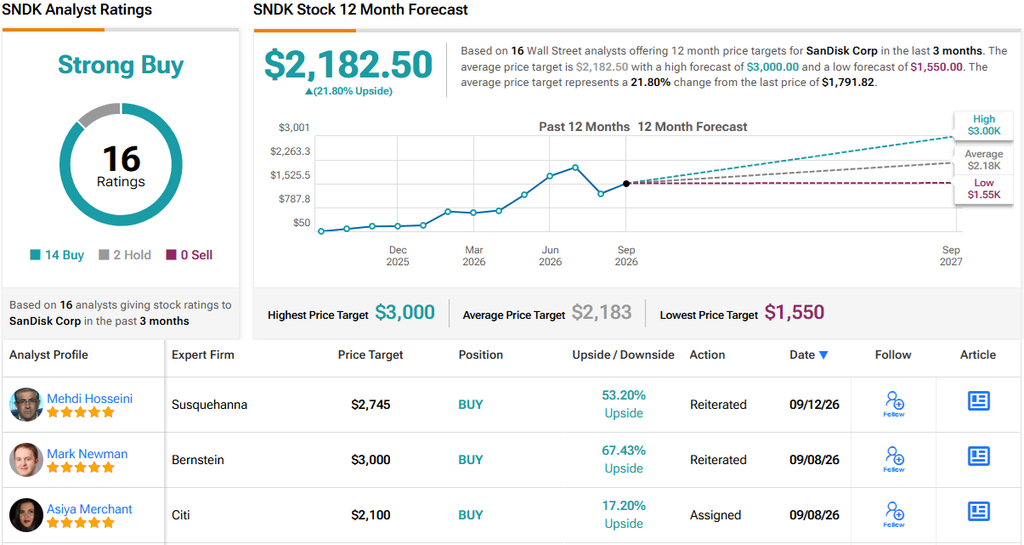
Pajjuri’s caution puts him well outside the prevailing view on Wall Street. Among 16 analysts, 14 recommend buying SNDK and only two remain on the sidelines. The $2,182.50 average price target points to nearly 22% upside from Friday’s close. (See SNDK stock forecast)
CoreWeave
CoreWeave has carved out a distinctive role within the AI infrastructure boom, offering cloud computing built for demanding workloads. Rather than designing semiconductors, CRWV provides developers with access to high-performance GPUs, storage, networking, and software required for training sophisticated models at scale.
That approach separates CoreWeave from traditional cloud providers serving a much wider collection of computing needs. Its platform was designed around GPU-intensive workloads from the beginning, allowing customers to secure vast amounts of computing capacity without constructing costly data centers themselves.
Nvidia also plays an important role in the CoreWeave story, given their close relationship and extensive use of the chipmaker’s hardware. CRWV has frequently been among early cloud providers deploying Nvidia’s newest GPU systems, giving AI developers another route toward cutting-edge computing resources.
Yet, owning CRWV has hardly been an easy ride during the past year, with shares losing about 33% over that period. Much of the market’s concern has focused on what CoreWeave must spend to keep expanding its infrastructure while keeping pace with demand. Principal debt obligations reached $35.6 billion at the end of Q2, while interest expense totaled $985 million during 2026’s first six months. Cash paid for property and equipment reached $14.1 billion during that period, while persistent losses, customer concentration, hyperscaler competition, and potential dilution have given investors several risks to weigh.
Those concerns returned last week after management launched a convertible-note offering that was subsequently upsized to $3.7 billion, alongside an ATM program covering up to 35 million shares.
Still, CoreWeave’s latest earnings showed that demand continues translating into rapid revenue growth. Second-quarter sales climbed 112% year-over-year to $2.58 billion, beating expectations by $20 million, while GAAP EPS of negative $1.14 came in $0.33 ahead of estimates.
Management also raised its full-year revenue outlook to between $12.4 billion and $13.2 billion, compared with the previous $12 billion-to-$13 billion range. Adjusted operating income is now expected between $960 million and $1.15 billion, up from the prior $900 million-to-$1.1 billion forecast. Looking toward Q3, management expects sales between $3.45 billion and $3.6 billion, placing the $3.525 billion midpoint close to Wall Street’s $3.54 billion consensus estimate.
Billionaire Cliff Asness clearly sees an opportunity worth pursuing, judging by AQR Capital’s latest portfolio disclosure. During Q2, his fund increased its CRWV stake by 6,111%, purchasing another 1,050,817 shares.
Rosenblatt analyst John McPeake takes an even more bullish view of CoreWeave’s prospects, standing far above every other CRWV analyst on Wall Street. McPeake assigns CRWV shares a Buy rating alongside a $250 price target, which implies about 207% upside from current levels. (To watch McPeake’s track record, click here)
“Our checks are consistently pointing to CoreWeave as the company that can deliver significant GPU capacity on-time and at spec. We think that if $47B of Vera Rubin GPU capex (our estimate) can drive $40B in annualized revenue (perhaps $20B for long-dated contracts) that driving every investable dollar into that equation makes perfect sense. This is especially true given that the useful life of those GPUs is likely well beyond their 6-year depreciation schedules,” McPeake opined.
“CoreWeave should see their leverage come down as a result of both their likely upcoming financing and better profitability and leverage against their CapEx spending at scale,” the analyst added.
McPeake may be reaching much higher than his peers, but Wall Street is hardly writing off CRWV. Of the 23 analysts tracking the stock, 16 have Buy ratings, compared with 6 Holds and a lone Sell. The $143.57 average target leaves 76% upside from current levels. (See CRWV stock forecast)

Disclaimer: The opinions expressed in this article are solely those of the featured analysts. The content is intended to be used for informational purposes only. It is very important to do your own analysis before making any investment.