
Unlock the Editor’s Digest for free
Roula Khalaf, Editor of the FT, selects her favourite stories in this weekly newsletter.
Mark Zuckerberg is poised to unveil Meta’s latest AI devices on Wednesday, as the social media group rides high on the early success of its new personal AI agent app Muse.
Meta is holding its annual Connect event at its Silicon Valley headquarters this week. The event has become Zuckerberg’s main venue for launching its latest hardware, from virtual reality headsets to smart glasses.
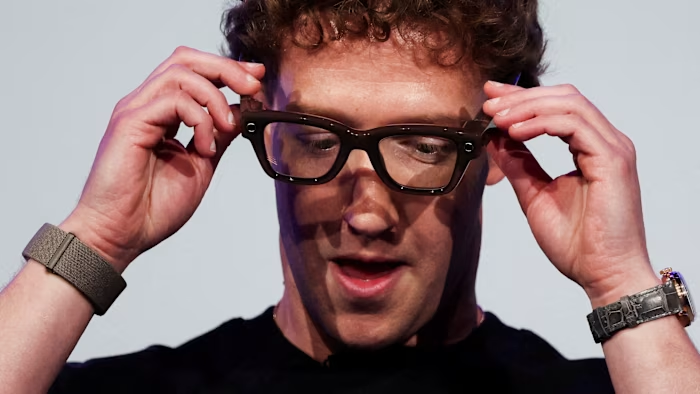
The Meta chief has doubled down on his bet that smart glasses and other portable devices will become one of the main ways consumers interact with AI, despite critics dubbing its camera-toting Ray-Bans “pervert glasses” after intrusive videos hit Instagram and TikTok.
Zuckerberg has come under increasing pressure from Wall Street as he pours billions of dollars into AI infrastructure and talent, with Meta’s share price falling by more than a quarter between last September and the beginning of August.
But Meta’s stock has bounced back over the past month, including adding more than $300bn in market value since the launch of its new AI assistant app Muse two weeks ago. The easy-to-use app offers consumers a team of autonomous bots to carry out everyday tasks, such as ordering groceries, booking travel and organising finances.
Muse has quickly become the most downloaded app on both the Apple and Android app stores in the US. Meta’s share price has jumped 21 per cent since the September 8 launch, taking the company to a $1.9tn market capitalisation.
The release of a breakout product to Meta’s 3bn users caps a turbulent two years in which Zuckerberg has repeatedly struggled to compete with OpenAI and Anthropic in developing frontier AI models and features.
Whether Zuckerberg will emerge vindicated in his AI strategy — for both his Muse assistant and AI wearables — will depend on whether the new features can withstand potential privacy and security issues as its user base grows.
Over recent months, a backlash against widespread misuse of Silicon Valley giant’s Meta Ray-Bans smart glasses has gained momentum.
Sold in partnership with eyewear group EssilorLuxottica, the glasses have inbuilt speakers, microphones and cameras that can be used to take photos, listen to music and chat with Meta’s AI.
Critics claim they are being used to record others without their knowledge. Currently the Meta glasses have an LED in the corner of the frame that lights up to signal to others when a wearer is taking photographs or filming.
Meta dominates the smart glasses market, which remains nascent, but rival devices from Google, Samsung and Apple are on their way. Counterpoint Research estimates AI glasses unit shipments grew by 263 per cent in the first half of the year.
Meta hopes the Muse assistant, development of which was first revealed by the FT in May, will be able to become highly personalised for users if it is able to access data from activity on its social platforms.
The company will have to convince consumers to connect personal data such as their email inbox, financial services apps or calendar with the bots, which run on the social media group’s Muse family of models, at a time when AI agent technology can still make errors or potentially go rogue.
Meta has already had to issue a fix for a vulnerability that could allow a hacker to take control of another person’s Muse agent. Amazon, meanwhile, has blocked Meta’s agents from accessing its shopping platform as part of efforts to prevent third-party bots from using its systems.
Meta is so far the only large AI lab to have rolled out a consumer-friendly agentic assistant, though others may soon follow. Before the Muse launch, a small invite-only personal AI assistant from start-up Instinct started to go viral. Other rivals, such as OpenClaw and SpaceX’s Grok Bot, are pitched at more technically adept developers or corporate users.
Muse, which is initially being launched to adults in the US for free, with paid tiers for higher usage priced at $20 and $100 a month, will not share data with Meta’s advertising systems, the company has said.