
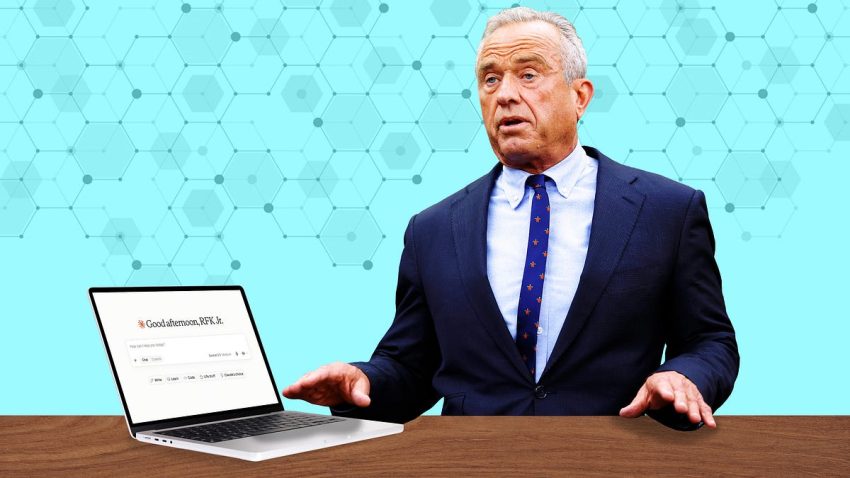
ROBERT F. KENNEDY JR. BECOMING a huge AI cheerleader probably wasn’t on your 2026 bingo card. It certainly wasn’t on mine.
But there was Kennedy on Tuesday, speaking in his capacity as the secretary of health and human services, talking about the potential of artificial intelligence to help pinpoint what’s wrong with people when they are sick or injured.
“It would be malpractice for a doctor to make a diagnosis, or to make a prescription, without at least checking AI,” Kennedy said at a MAHA Action conference in Washington.
MAHA, of course, stands for “Make America Healthy Again,” the movement that Kennedy has been leading, which is known for its hostility to all things artificial. But Kennedy doesn’t see AI as yet another way for science to disrupt the natural order. Rather, he said to the MAHA attendees, AI will let average people challenge the establishment of doctors and scientists, and make up their own minds about what constitutes good medical care.
As an example, Kennedy suggested how people could have used AI during the COVID pandemic, when public health officials promoted vaccination as a way to protect the elderly and others with weaker immune systems. “If somebody tells you that a vaccine will prevent transmission and infection, or you need to take it to protect your grandmother, AI may say it actually doesn’t do that,” Kennedy said.
Or to put it more bluntly, as Kennedy did later, AI would “free us from medical tyranny.”
It might surprise you to hear I think Kennedy is right about the potential of AI to transform medicine, and in a good way. Some of the most promising possible uses of AI—assuming it doesn’t, you know, extinguish humanity—lie in its ability to help providers make more accurate diagnoses.
The immense value of AI systems in making diagnoses in fields where they can be trained on enormous datasets has been widely recognized over the past few years; for example, in diagnostic imaging, by training on vast numbers of x-rays, CT scans, MRIs, and ultrasounds, AI systems can detect diagnostic patterns too subtle or complex for even experienced clinicians to detect consistently.
The potential value of AI is also growing in fields like cancer treatment, where the sheer volume of relevant clinical information is so great—and changing so quickly—that even the most capable oncologists can’t keep it all in their heads.
“The data are pretty good that AI is more accurate than physicians at creating a differential diagnosis,” Ezekiel Emanuel, the University of Pennsylvania oncologist, bioethicist, and author, told me over email. He and two collaborators recently generated some controversy by suggesting in a Journal of the American Medical Association article that medical decision-making by AI alone was frequently superior to decision-making by doctors who merely consult AI. But, Emanuel told me, you don’t even have to believe that to see the upside potential.
“In many cases there is not going to be a need to check with AI,” Emanuel said. “But in hard cases, there may be good reason to check with AI. All physicians have had ‘tough cases’ that do not exactly fit with symptoms or lab tests that puzzle them.”
AI could also boost health care by operating as a force multiplier: It can enable professionals without the full training of a doctor to provide front-line medical care in places where doctors are in short supply.
Experts have talked for years about tapping that potential as a way to help some of the most impoverished parts of the world—or even impoverished parts of the United States. And in the past few months, Mehmet Oz, administrator of the Centers for Medicare and Medicaid Services, has been touting AI’s potential as a way to address provider shortages in rural areas.
The reason AI can do all of that is that it excels at gathering, digesting, and applying information—including scientific data. And this characteristic makes it useful for debunking charlatans, cranks, and conspiracy theorists, including those peddling unfounded claims about the dangers of vaccines.
In other words, it’s a terrific fact-checker for Kennedy, as I discovered myself last week.
INSPIRED BY HIS CALL TO USE AI, I went ahead and asked Claude (Anthropic’s AI assistant) to analyze some of Kennedy’s more memorable statements. I used the professional, paid version, because it provides access to more capable AI models that can produce more accurate results, and I started with one of Kennedy’s favorite claims: that the scientific community hasn’t seriously investigated links between vaccines and autism.
Kennedy has cited this alleged failing to justify his agenda of unwinding federal support for vaccines. A version of the statement now even appears on the website of the Centers for Disease Control and Prevention. To get an accurate read on it, I fed Claude a recent version of Kennedy’s linkage between vaccines and autism—one he gave just a few weeks ago during a speech to Children’s Health Defense, the organization that he led from 2015 to 2023 and that has done as much as any to undermine faith in vaccines.
Here was the quote, which refers to eighteen vaccines the CDC has been recommending for children:
In fact, of all of those ninety-four doses of the eighteen vaccines, only one of them was subject to a placebo control trial and that was the COVID vaccine. The other ones were like this. There was no safety study. We have no idea what the risk profile is for these products. And you know that means we can’t really make the kind of risk-benefit analysis that my agency is supposed to do.
Claude’s verdict:

The first misleading claim was on the number of doses (which Kennedy inflated). The second was about the supposed lack of placebo testing, which Kennedy says all the time and which—as infectious-disease experts like Stanford University’s Jake Scott have noted repeatedly—is simply not true. As for the third claim, that “there was no safety study,” here’s Claude’s take:
This is the most clearly false part, and it goes further than the placebo claim. A trial without a placebo is still a safety study. Head-to-head trials against existing vaccines collect safety data, and so does post-licensure surveillance. . . . The HHS website itself says every authorized or approved vaccine goes through safety testing, including clinical trials and monitoring after reaching the market. The 2013 [Institute of Medicine] report on the schedule, which Kennedy cited in this same speech, found no evidence that the schedule is unsafe.
The kernel of truth in Kennedy’s argument (which Claude duly noted) is that scientists don’t typically test new versions of old vaccines against placebos. They test new vaccines against the existing vaccines. As Claude went on to say, that’s because testing against a placebo in those cases would be unethical—you’d be knowingly exposing children to a dangerous, potentially deadly disease like measles—and is unnecessary because studies have already shown the original vaccine to be safe.
Speaking of measles, that vaccine has been in the news a lot lately because the disease has returned to the United States after more than twenty years of “elimination” status, causing outbreaks and multiple deaths. The reason is falling vaccination rates. But Kennedy, rather than using his position to encourage vaccination, continues to suggest the shots may be dangerous.
One supposed source of the danger is the clustering of three full shots (one each for measles, mumps, and rubella) into a single MMR shot. President Donald Trump has made a big deal about that, calling for the shots to be delivered separately, and Kennedy stood by that during an August CNN interview when he said “There is a recent study that just came out that supports President Trump on that. It looks at the timeline for when the autism epidemic began and . . . it’s a synthesis of—essentially a meta-review—of all the existing science. And it very strongly supports the president.”
Claude’s verdict:

After searching for references in the popular press—including from Factcheck.org, which has been doing heroic work scrutinizing Kennedy these past two years—Claude did its own literature search. It found no credible evidence to substantiate Kennedy’s statement, and instead concluded that “the recent published research points the other way.”
The truth is rarely as tidy as we’d like it to be.
That’s why we think journalism should be a process of discovery—not a daily exercise in confirming what everyone already believes.
We follow the facts. We argue about what they mean. We learn from one another. We admit when we get things wrong. And, whenever possible, we have a little fun along the way.
If that sounds like a community you’d like to be part of, come on in.
CLAUDE WAS CAREFUL TO NOTE—accurately—that Kennedy’s claims typically start with real facts or studies, which give them the veneer of credibility if you don’t know the context or understand the way he’s twisting the implications.
One example of this chicanery is the way Kennedy talks about an earlier version of the polio vaccine, which was grown in monkey cells. A virus infected some of the cells that produced vaccines between 1955 and 1963. Here’s how Kennedy used that story during a 2023 podcast interview:
The polio vaccine contained a virus called simian virus 40, SV40. It’s one of the most carcinogenic materials that is known to man. In fact, it’s used now by scientists around the world to induce tumors in rats and guinea pigs in labs. But it was in that vaccine—98 million people who got that vaccine, and my generation got it, and now you’ve had this explosion of soft tissue cancers in our generation that killed many, many, many, many more people than polio ever did.
That claim has stuck with me because polio was such an awful disease, causing more than 3,000 deaths and many more cases of paralysis in 1952, the peak year before the vaccine’s 1955 introduction. The polio vaccine is in many ways the quintessential vaccine success story, and here Kennedy was suggesting that, rather than a medical miracle, the shot had been a nightmare.
Except it was a miracle. Kennedy’s statement was “false,” according to Claude:

Kennedy had botched some of the statistics and suggested a link between the virus and human cancer that studies have not established, Claude reported, though the AI interface told me the biggest problem with Kennedy’s argument was about the supposed “explosion” of cancers:
The population data don’t show one. [The Institute of Medicine]’s summary: studies of people who received polio vaccine during 1955–1963 provide evidence of no increased cancer risk. A meta-analysis of five published studies did not support the idea that SV40 exposure increases overall cancer incidence or cancer mortality. [The National Cancer Institute] told Congress in 2003 that follow-up of vaccine recipients showed no excess of cancer, including a study of 1.8 million recipients of a widely contaminated Danish polio vaccine.
But sometimes Kennedy’s distortions are less subtle, especially when it comes to the COVID-19 vaccines. Kennedy famously described them as “the deadliest ever made.” Claude judged that claim “false”:

The source is the federal Vaccine Adverse Event Reporting System, or VAERS, through which people can report injuries and illnesses after vaccination. The CDC and the FDA use reports as possible safety signals, which they investigate, but absent evidence confirming the injuries—and linking them to vaccines—they don’t prove anything. As Claude noted, “The system’s own disclaimer says report counts can’t be used to draw conclusions about whether, how often, or how severely vaccines cause problems.”
DIFFERENT AI MODELS are trained differently, and can use different approaches to reasoning and problem-solving. So I tried another AI assistant, OpenAI’s ChatGPT. Here’s how it rated the four Kennedy claims:
-
False / seriously misleading.
-
Unsupported / misleading, and the characterization of the study is wrong.
-
The first part is true; the central cancer claim is unsupported/false.
-
False.
Then I turned to Google’s Gemini. Here was its response:
-
False / Highly Inaccurate
-
False / Unsupported by Science
-
Inaccurate and Misleading
-
False / Factually Incorrect
Finally I went to Grok, Elon Musk’s AI assistant, and got this:
Yes, even Musk’s chatbot was reacting to Kennedy with the AI equivalent of AYFKM.
I can’t say any of this surprised me. In reporting on Kennedy over the past year, I’ve read every reputable source I could find and spoken to at least a dozen different scientists about Kennedy’s claims. They have been unanimous in their opinion that Kennedy is not just wrong, but very, very wrong. But just to be sure, I checked with Emanuel too.
“The great thing about using AI to check medical information,” he told me, “is that it shows RFK Jr. doesn’t know what he is talking about.”