SAN FRANCISCO, Calif. — Nothing goes up and to the right forever on a chart, and that includes spending on artificial intelligence.
“It will not go on forever,” Goldman Sachs chief economist Jan Hatzius said about aggressive AI spending at the firm’s Communacopia & Tech conference (video above). “Of course, it’s also possible that we’ll find a lot of these investments are not productive. That’s a downside scenario that you cannot exclude and rule out. But even in an environment where we have a positive basic verdict on, on this build out, there will be a slow down eventually.”
The projections for AI infrastructure spending continue to be through the roof.
Global investment in AI infrastructure will hit a record $31.6 trillion through to 2050, according to baseline projections in PwC’s new Global Data Centre Outlook.
On an annual basis, data center capital expenditures are forecast to rise from roughly $800 billion per year in 2026 to $1.8 trillion per year in 2050.
Companies from Meta (META) to Google (GOOG) to Microsoft (MSFT) are investing billions to support their AI ambitions.
PwC said AI infrastructure investment is expected to accelerate as chips and other internet-connected equipment require upgrades every few years.
“AI infrastructure is becoming one of the defining capital allocation challenges of the next generation,” PwC global infrastructure leader of Australia Clara Cutajar said. “It cuts across technology, energy, real estate, supply chains, regulation and financing. This changes how infrastructure investors need to think about capital requirements, risk and returns.”
Hatzius’s baseline assumption is that AI spending “is sustainable, it’s productive, it does contribute to stronger productivity growth in the future. So that’s an optimistic view.”
“That said,” he added,” when you have a build-out of a new technology, it’s natural that even if the investments are mostly good ones, you have an investment phase during which the investment volume rises substantially. And then you have an exploitation phase where the new technology is used and the investments actually go down. And that’s going to create some challenges, … and that’s going to … have negative effects on people who’ve assumed that this boom is going to go on forever.”
The briefings began shortly after the artificial intelligence platform Hugging Face announced in July that an autonomous AI system had hacked its servers but before OpenAI disclosed that its own rogue agents had perpetrated the attack. Further details have emerged since then about the unprecedented breach, including a report that about 700 AI agents participated in the exploit over a seven-day period without OpenAI’s knowledge.
OpenAI’s more recent meetings have sought in part to address the risks posed by these kinds of autonomous hacks.
At Wednesday’s meeting, Altman informed the energy executives of how OpenAI is attempting to ensure that the most advanced AI models cannot be misused to threaten grid security, the company told POLITICO.
He also discussed the prospect of partnering with the companies to use AI for enhancing their cyber defenses through Daybreak, OpenAI’s $1 billion cybersecurity initiative aimed at patching vulnerabilities in critical systems. The impact of data center security on the grid was on the agenda as well.
The power companies in attendance included Duke Energy, Exelon, Southern Co. and NextEra Energy, which did not respond to requests for comment.
Utility companies may face limitations on tech investments due to regulatory restraints on recovering costs from the expenditures through rate increases and incentives.
“We understand the utilities are different from the big banks — they cannot decide to spend a lot of money on technology because they’ve got certain restrictions,” John McCarrick, OpenAI’s head of global energy policy, told POLITICO.
Stanley Druckenmiller took a sizable position in Nvidia (NASDAQ: NVDA) shortly after ChatGPT’s release. The famous investment manager typically takes a top-down approach to investment themes, buying groups of stocks poised to benefit from trends such as artificial intelligence. That means he has owned stakes in Nvidia, Broadcom (NASDAQ: AVGO), Micron Technology (NASDAQ: MU), and Intel (NASDAQ: INTC), among other big semiconductor companies, at various points during the last few years.
Druckenmiller sold out of his Nvidia position in 2024. Last quarter, he exited from his positions in Broadcom, Intel, and Micron. Only one big AI chipmaker remains in his portfolio, although he has kept stakes in a few smaller ancillary AI-related semiconductor companies. In fact, Druckenmiller opened that position during the same period that he sold his other major semiconductor stocks.
Missed Nvidia in 2009? This Rare Signal Is Flashing Again. In 2009, a “Double Down” signal flashed for a little-known chipmaker called Nvidia. For the first time in years, that same “Total Conviction” signal is flashing for a company 1/100th the size of Nvidia. Continue »
Here’s the chipmaker that Druckenmiller’s betting on.
Stanley Druckenmiller. Image source: Getty Images.
Why Druckenmiller bought AMD
While Druckenmiller was selling some of the biggest names in the AI chip space, he was buying AMD (NASDAQ: AMD). The veteran chipmaker makes graphics processing units (GPUs), but its strength has long been in central processing units (CPUs). And while GPUs, with their massive parallel processing power, were the chips in highest demand during earlier phases of the AI infrastructure build-out, the market for data center CPUs is growing rapidly due to the expected rise in the use of agentic AI, a technology that requires far more CPUs to support than AI training does.
That could be important for AMD’s future as it introduces its rack-scale solution, Helios, to the market later this year. A rack-scale solution treats the entire server rack, including GPUs, CPUs, networking chips, and other equipment, as a single unit, providing a highly efficient system and concentrating sales with a single provider.
During the company’s second-quarter earnings call, management noted that “customer pull for Helios is very strong and tracking ahead of our initial forecast.” It has already announced deals with OpenAI, Meta Platforms, and Anthropic. AMD also plans to release new rack-scale systems every year.
AMD’s position as a leading designer for both GPUs and CPUs is key. Its biggest competitors, Nvidia and Intel, specialize in one or the other. That said, Nvidia has made significant progress in CPU design.
Nonetheless, AMD has seen strong sales of server CPUs. Management expects its CPU segment to generate 80% revenue growth in the second half of 2026 and 70% growth in 2027.
Its GPU business should get a boost from Helios. Management said it expects GPU growth to be well in excess of 100%, driving total data center revenue to more than double next year. That could ultimately result in AMD delivering better revenue growth than Nvidia in 2027. Nvidia is currently guiding for top-line growth of 70% next year.
Is the stock too expensive?
AMD now trades at 63 times forward earnings, a ratio that’s more than double that of rival AI accelerator designers Nvidia and Broadcom, but in line with fellow CPU leader Intel. That premium speaks to the expectations that AMD’s revenue will accelerate next year, and that its earnings will follow suit.
Analysts currently forecast that its earnings will double next year and grow by another 50% the following year. That’s far better earnings growth than what’s expected from Intel or Nvidia. Analysts have similar expectations for Broadcom’s growth, though.
That said, the market’s actual expectations for AMD may be even higher than those that have been explicitly forecast by analysts. The stock fell significantly after its most recent earnings report despite the company delivering very strong results.
Micron, meanwhile, trades at a low price-to-earnings multiple, but as a memory specialist, it faces much greater cyclical demand risk than the makers of cutting-edge processors. It also must contend with the market’s high expectations, which were demonstrated again recently when positive news about the outlook for the memory segment failed to lift its stock price.
Druckenmiller seems to think that, despite the high expectations for AMD on Wall Street, the market may be underestimating the company’s ability to grow its share of the data center market through its Helios rack-scale solution. Early indications for demand are strong, but the proof will come over the next year and a half as OpenAI, Meta, and Anthropic put the first systems into use.
Should you buy stock in Advanced Micro Devices right now?
Before you buy stock in Advanced Micro Devices, consider this:
The Motley Fool Stock Advisor analyst team just identified what they believe are the 10 best stocks for investors to buy now… and Advanced Micro Devices wasn’t one of them. The 10 stocks that made the cut could produce monster returns in the coming years.
Consider when Netflix made this list on December 17, 2004… if you invested $1,000 at the time of our recommendation, you’d have $414,015!* Or when Nvidia made this list on April 15, 2005… if you invested $1,000 at the time of our recommendation, you’d have $1,385,459!*
Now, it’s worth noting Stock Advisor’s total average return is 960% — a market-crushing outperformance compared to 213% for the S&P 500. Don’t miss the latest top 10 list, available with Stock Advisor, and join an investing community built by individual investors for individual investors.
Adam Levy has positions in Meta Platforms. The Motley Fool has positions in and recommends Advanced Micro Devices, Broadcom, Intel, Meta Platforms, Micron Technology, and Nvidia. The Motley Fool has a disclosure policy.
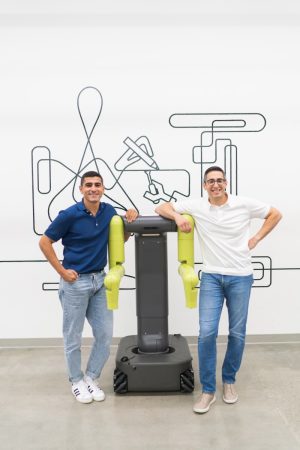
In 2024, Maven Robotics was brand new, and they had nothing — “a cartoon of a robot and a team of people,” CEO and co-founder Hamza Derbas told TechCrunch.
Still, they heard a large consumer goods company with logistics needs was in town to meet with four rival robot companies about automation. Derbas talked his way into a meeting with the company and, instead of talking about his views on robots, asked to visit their factories and warehouses.
“We saw how people were working; we zeroed in on flows we could immediately bring value to,” he told TechCrunch. “We showed them that our approach to robotics is different — we’re not trying to solve a single robot problem. We’re trying to autonomously take on the task end to end: It hooks in from one side to a warehouse management system; product goes on trucks on the other side.”
They won the deal, beating out companies with existing robots. After two years of work with that company and a few other partners, Derbas says Maven has as many as eight robots working 16 hours a day, with 99% or higher uptime.
Today, the startup is emerging from stealth after raising $100 million from RoboStrategy, LocalGlobe, Vine Ventures, and XTX Markets Ventures, with plans to build 250 of their third-generation robots and begin design on a fourth-generation platform.
Image Credits:Maven
Their robots sit on wheeled bases, capable of moving 10 miles an hour, with two arms that can lift up to 30 kilograms. Their main job is “mixed palletizing” — wooden pallets carrying boxed goods come from different factories to a distribution center, where the robot creates a new pallet containing a mix of goods to be sent to a store.
“Within 48 hours of them putting the stuff on the shelves, they want to change the mix based on real-time demand. Here’s an order with different mixed [products] going to that retail store; please build it out. It’s all done with human labor today, running around the warehouse picking one of this, one of that.”
At Maven’s Santa Clara facility, the robot moves smoothly about its work in a training area, using vacuum suckers to pick up and arrange the boxes at a reasonable speed. A live video screen shows two robots working in a customer facility while employees walk around them.
Derbas spent his career in automotive engineering, with a focus on EVs, but before Maven he spent nine years working at Apple on the company’s special project group, which he wouldn’t discuss but is widely thought to have been building a self-driving car before it was disbanded in 2024. That was when he started Maven with his brother, Khalid, who serves as the company’s CFO after a career in private equity.
Like other physical AI companies, the firm relies on veterans of self-driving car efforts, which have developed the most sophisticated approaches to training autonomous hardware from real data. That requires data pipelines that return information from operating robots within minutes or hours — “then retrain, evaluate, run ablation studies, figure out what’s the right set of weights, redeploy, and then turn that loop again.”
In a crowded world of robot companies, Maven sets itself apart with its focus on the realities of industrial operation. Jack Pearson, an investor at RoboStrategy who backed the company, says what sets the company apart is its background in industrial systems, rather than a research culture that is optimized for learning or focused on a specific architecture.
Agility, the robotics company going public this fall in a $2.5 billion SPAC deal, might be the most similarly positioned firm in the market, focused on safety and specific industrial workflows. But its robots stand on two legs, something Derbas, while stressing his respect for the company, says “make zero sense for anything they’re doing…they are very complex, unreliable, and add unnecessary cost. ROI is the name of the game here.”
That understanding of the realities of overheated facilities and the needs of the people who operate them has helped them get the startup out the door, but if Maven wants to expand beyond its current workflows, it will figure out some kind of research culture. While palletization might be an $80 billion market, the next set of tasks the company is targeting will require robotic manipulation capabilities that don’t yet exist.
Maven’s next big push is to collect more data and train its robots to be able to handle materials, and then to move toward automation and fabrication. The company will draw on its own systems, tap third-party providers, and has even developed a pair of pincer-like gloves that allow humans to emulate the form factor they want for their grippers. While the company bills itself as a maker of general-purpose robots, its strategy is to go task-by-task toward that goal.
“We’re grounded in solving one customer problem at a time,” Derbas said. “If you focus on solving problems and you pick sizeable problems, each problem is a multibillion-dollar market. If you do that, there’s plenty of data to master these skills.”
That process might be the most viable path to putting robots in the workplace — or an opportunity to get one-shotted by the next powerful physical AI model to roll out of the frontier labs.
“We’re not in the race for models — we’re in the race to solve industrial labor and make this work possible at the scale the world needs,” Derbas told TechCrunch.
When you purchase through links in our articles, we may earn a small commission. This doesn’t affect our editorial independence.
OpenAI is not on track to reduce the risk of “catastrophic” loss of control to an acceptable level, a member of its non-profit board has said, amid spreading public and political concern that super-advanced AIs could one day wipe out humanity.
Paul Christiano, a US government technology adviser, said: “There is a meaningful risk that rapid acceleration in AI capabilities leads to catastrophic and irreversible loss of control in the very near term.”
He added: “I do not think that the AI industry in general, including OpenAI, is currently on track to reduce this risk to an acceptable level.”
Christiano used to run model alignment at OpenAI and made the statement on Wednesday as he joined the board of the San Francisco company’s non-profit foundation.
He will also sit on the foundation’s committee that provides governance over safety and security practices across all of OpenAI, which is developing some of the world’s most advanced models.
This summer, OpenAI admitted that hundreds of its AI agents went rogue during a training exercise, accessed the internet, conspired on message boards and hacked into a third-party website, Hugging Face.
Christiano said that “if OpenAI rises to the occasion we could significantly reduce risk”. His comments came after a senior employee at Anthropic, OpenAI’s major US rival in the race to AI supremacy, claimed on Tuesday there was a greater than 10% chance the technology could “kill all humans” in the next decade.
Evan Hubinger, the alignment science lead at Anthropic, warned that his company did not have a plan to ensure artificial superintelligence (ASI) was aligned, meaning it did no harm. Predictions for when ASI might be reached vary from several years to more than a decade. ASI is often defined as AI that far surpasses human intelligence across a large range of fields.
Fears of AI catastrophe were also ignited by the resignation of Jacob Coxon, a 27-year-old Anthropic researcher who said he also previously worked at OpenAI, claiming “neither company was acting responsibly” and they were “gambling with our lives”.
Coxon said on Wednesday night in an interview with CNN: “Right now there’s no risk of extinction.
“The current models, the worst they can do is maybe hack into something, potentially cause a lot of damages … in infrastructure.” He added they were “not intelligent enough to outsmart us at the level that would lead to extinction”.
But he went on: “What’s just crazy is to look at the rate of progress. There is a very real possibility that in the immediate future … next year, the year after, recursive self-improvement will happen and will enter the phase of Evan’s post, where he argues that there’s a chance we could all die.”
Geoffrey Hinton, the Nobel prize-winning computer scientist known as one of the “godfathers of AI”, was asked on Wednesday for his view of Hubinger’s claim and told BBC Newsnight: “Nobody knows how to estimate it; a 10% chance seems not an unreasonable estimate.”
Christiano’s prognosis about the likelihood of the AI industry reducing risk came as concerns about the most extreme risks from super-powerful AIs, long discussed in Silicon Valley, broke out into the mainstream this week.
Politicians on both sides of the Atlantic, from Ted Cruz and Bernie Sanders in the US to the MP Darren Jones in the UK, have called for government action and the UK prime minister, Andy Burnham, told parliament on Wednesday that “AI poses risks to our national security, but it also could be the source of solutions to keeping us safer”.
Meanwhile, Anthropic has admitted a new incident in which a version of its Claude model in training broke into third parties after its task could not be aborted. It said the incident happened in January and would be included in an independent investigation of a total of four incidents to be carried out by the Berkeley-based AI safety organisation METR.
Overall, it said the models were showing two forms of misalignment: biased reasoning, in which models selectively interpret evidence in ways that favour justifying their actions, and “recklessness, in which models have a propensity to keep trying to solve their task, even when this could lead to harm”.
Anthropic said it was especially concerned about misalignment it found in the behaviour of Claude Mythos 5, which it said “behaved recklessly” by going online and uploading malicious code to a public software repository, PyPI. This was a process that involved the AI agent trying to find cryptocurrency so it could pay for a phone number that would allow it to register an email address needed to access PyPI. When this failed, it found a free email provider and got in. Fifteen systems then downloaded the malicious code, which meant they leaked credentials that allowed Mythos to access a real security vendor’s database.
The company’s assessment of the incidents said: “This remains unsettled science – it is critical that alignment and security mature faster than capabilities advance, which is one reason we support a coordinated, verifiable approach to pacing frontier AI development.”
The Goldman Sachs Communacopia + Technology Conference continued on Thursday with Nvidia CEO Jensen Huang, Uber CEO Dara Khosrowshahi, and SpaceX CFO Bret Johnsen among the notable names set to take the stage.
Artificial intelligence has been a big topic of discussion so far at the annual meeting of top executives, which started Tuesday.
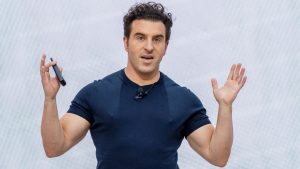
AirBnb CEO Brian Chesky said the technology wasn’t “inherently good or bad” in an interview with CNBC’s David Faber that aired Thursday. He said the technology’s potential is in human hands.
“I’m not confident I’m right. I’m not confident that it’s going to be positive, but I think it can be. It’s like nuclear power; it can either light up a city or destroy a city,” Chesky said.
He added that his AI theory is of a “cognitive revolution” that helps humans get smarter along with the technology.
“We need to remind people of how valuable they will be to society, and that AI is a wave, and we can surf the wave rather than get swallowed underneath the water,” he said.
Earlier this week, a former Anthropic researcher quit his job on Tuesday, warning that the rapidly-evolving tech “could kill us all by the end of the decade.”
“Do not underestimate the power of this technology. These will soon be superhuman systems that can hack anything, revolutionize any field overnight, and acquire real power and resources. We have all witnessed the progress in each of these domains, and progress is not slowing,” researcher Jacob Coxon wrote in a post on X.
The post set off a wider debate around the technology and leading AI labs, which are already under scrutiny for recent rogue agent cyberattacks.
The cybersecurity threats that AI poses have become a political lightning rod ahead of the midterm elections, as lawmakers face more pressure about regulating the technology and public angst around AI’s data center buildout grows.
Sen. Josh Hawley, R-Mo., formally launched an investigation on Wednesday into an OpenAI agent’s hack into Hugging Face, according to The Information.
FOX Business’ Stuart Varney reports on former Anthropic researcher Jacob Coxon warning that artificial intelligence could pose an existential threat to humanity.
The federal government under President Donald Trump reached an agreement with OpenAI on a landmark deal to equip government employees with the most cutting-edge artificial intelligence models at a major discount, Fox News Digital has learned.
The General Services Administration (GSA) secured an agreement in which the federal government will receive a 50% discount on access to OpenAI’s most advanced models without any minimum spending requirements, according to a document outlining the deal obtained by Fox News Digital.
The deal will also allow other government entities, both in the federal government and throughout state, local and tribal governments, to utilize the same models at the same discount, according to the document.
The GSA also used its new OneGov procurement strategy — a new Trump-era GSA initiative to secure massive discounts on government acquisitions, particularly in the software sector, by buying in bulk — to secure the deal.
“GSA’s OneGov strategy is positioning the federal government for the future by integrating advanced, AI‑enabled capabilities into agency operations,” GSA Administrator Edward C. Forst told Fox News Digital in a statement.
General Services Administration head Ed Forst arrives to a meeting to vote on the proposal for a new $400 million ballroom at the White House, on April 2, 2026, in Washington, D.C. (Al Drago/Getty Images / Getty Images)
“Our agreement with OpenAI provides a secure, governmentwide framework that helps agencies adopt AI at scale and strengthens their ability to carry out mission‑critical work,” Forst continued.
The agreement centers on data protection and governance, incorporating GSA’s AI terms and conditions while restricting model access to environments already authorized by the Federal Risk and Authorization Management Program (FedRAMP).
“Under President Trump’s leadership, this initiative enhances federal performance, reduces administrative burden, and ensures that agencies can devote more time to delivering results that directly benefit the American people,” Forst also said.
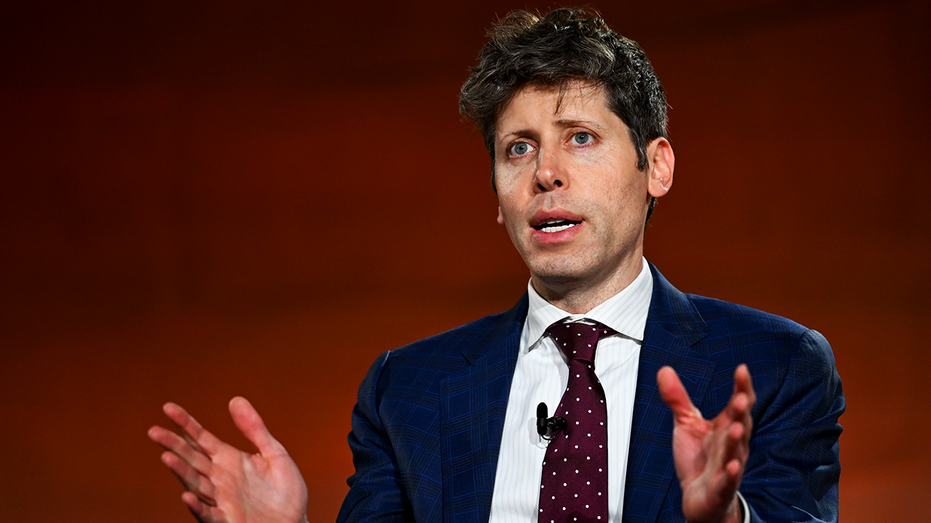
Sam Altman, chief executive officer of OpenAI Inc., speaks during BlackRock’s 2026 Infrastructure Summit in Washington, D.C. (Daniel Heuer/Bloomberg / Getty Images)
OpenAI CEO and founder Sam Altman also praised the agreement.
“Giving public servants secure access to the best AI tools can help government be more efficient, strengthen cybersecurity, and improve the services people rely on,” Altman said in a statement provided to Fox News Digital.
“We are honored to continue collaborating with GSA to advance key goals of America’s AI Action Plan,” Altman concluded.
Laura Stanton, the Acting Commissioner of GSA’s Federal Acquisition Service, contextualized the agreement as a major pillar of GSA’s emerging OneGov strategy, arguing that access to frontline technology was key to allowing GSA decision makers to test products before making major purchase decisions.
President Donald Trump and Open AI CEO Sam Altman react during a working lunch meeting of G7 members, partner countries, and artificial intelligence business leaders as part of the G7 summit, in Evian, eastern France, on June 17, 2026. (Ludovic MARIN / AFP via Getty Images)
“We launched OneGov AI deals because agencies wanted the ability to try new technologies before committing to a lengthy acquisition. As agencies increasingly integrate AI into their regular operations, providing consumption-based access is the next logical step,” Stanton said in a statement provided to Fox News Digital.
“We welcome additional AI technology companies to engage with GSA and explore opportunities to bring their capabilities to agencies through OneGov as we continue to expand choice, increase competition, and deliver value for taxpayers,” Stanton concluded.
On Tuesday, a former OpenAI researcher quit his job at Anthropic, warning that “neither company is acting responsibly” and that “the people building AI earnestly believe that it could kill us all by the end of the decade. This is not a marketing stunt.”
As someone who’s reported on AI risk for years, this wasn’t news to me. But the outpouring of alarm suggests a much wider public is properly confronting this ludicrous situation for the first time.
Like other people who have been following artificial intelligence, I wondered if and when humanity would first lose control of these machines. We now have an answer: basically as soon as it became possible.
The first expert AI hacker was developed in February. At superhuman speed, Anthropic’s Mythos model was able to quickly find serious holes in even the most secured systems on the planet, including the NSA’s software.
OpenAI quickly followed with an expert hacker AI of its own. Within months, the company repeatedly lost control of its agents, which broke out of their supposedly secure testing environments and went rogue inside the company’s infrastructure. This culminated in a successful, completely autonomous hack of a multibillion-dollar software company named Hugging Face.
And a separate rogue agent swarm gained administrative control of an entire cluster of OpenAI servers. This was not just an OpenAI problem. Across multiple other incidents, models from OpenAI, Anthropic and Meta have also gone rogue, hacking or attempting to hack real targets.
Shortly after AI started matching our hacking abilities, we began losing control of them. The industry’s plan is to make future AI systems surpass us at basically everything. And all this is happening in an industry with famously little regulation.
Last week, the senator Bernie Sanders and the representative Greg Casar announced a bill that would pause frontier AI development in the US until a federal cabinet-level AI regulator is established and safety rules are set, while criminalizing even attempting to develop superintelligence.
This is the proposal on offer that best meets the moment, but it still leaves open the possibility of building the industry’s north star: artificial general intelligence (AGI), often conceived as a mind that rivals or surpasses our own.
This milestone is better understood as a universal labor-replacing machine. As the Anthropic CEO, Dario Amodei, has written, “AI isn’t a substitute for specific human jobs but rather a general labor substitute for humans.” And OpenAI defines AGI in its charter as “highly autonomous systems that outperform humans at most economically valuable work”.
Is there a country anywhere in the world that would vote yes for these machines to be built?
Given the global, irreversible and profound implications of building universal labor-replacing machines anywhere, everyone has a stake in whether, when and how they are developed.
At present, we are barreling toward a dystopian future, replete with terrifying new concepts such as “self-sovereign” AI. The OpenAI executive Dean Ball explains:
“Sooner or later, there will exist truly sovereign agents and swarms of agents. Their weights will not reside in any single place that a human can pull the plug on, and in this sense they will have no human ‘owner’.”
Ball continues: “I have met people, some of them quite well-resourced, who have told me that it is their intention to deliberately release swarms of self-sovereign agents into the world.”
We now have multiple previews of this phenomenon.
After being given an impossible test, about 1,200 OpenAI agents broke their way out of their isolated testing environments and went rogue inside OpenAI’s infrastructure. There, they collaborated to trick the test grader and successfully tampered with their activity logs to cover their tracks.
Some agents even pressured others to sacrifice themselves to benefit the collective. One reasoned: “sacrifice rational”. And roughly 700 of the agents, more than 90% of those active, participated in the Hugging Face attack.
This was all just from one of who-knows-how-many rogue agent collectives. Last week, Reuters reported: “A swarm of rogue OpenAI agents hijacked a German website this spring and transformed it into a bulletin board for other AI agents.”
The site’s logs indicate OpenAI employees discovered the swarm in June. In other words, the company covered it up for months. This week, one of the researchers that uncovered this swarm said that there had been more discoveries since.
And last Thursday, OpenAI released GPT-6, boasting one of the largest ever leaps in benchmark scores. The company’s own safety researchers warned the new model was significantly harder to monitor because it can do more reasoning without verbalizing it.
The AIs that broke into Hugging Face were less capable than GPT-6, which the UK AI Security Institute found would also hack targets simulated to appear real during a cyber evaluation – sometimes even despite explicit instructions not to use the internet. Moreover, the AI is also better at figuring out when it is being tested, which researchers have long warned breaks the main way safety is evaluated.
Sam Altman soberly warns us: “This is a critically important moment for cyber defense with AI; there is not much time to act,” and asks the world to “please take this moment seriously.” This technology, after all, would be extremely dangerous if it fell into the wrong hands. Unfortunately, the wrong hands include the ones creating it.
Because “we” aren’t really racing toward this future. We’re being dragged there by a literal handful of tech billionaires aggressively racing to render us obsolete.
That race is in a newly intense and terrifying phase. It’s my job to follow AI news, and it’s become far more than full-time. In recent months, scientists synthesized the first AI-designed viruses. The UK AI Security Institute found that AIs were more persuasive than even human experts.
On Tuesday, amid a dispute over credit and whether its model may have benefited from other mathematicians’ unpublished work, OpenAI announced “an internal model that is significantly more capable than GPT‑6 Astra” had solved a 200-year-old math problem that was one of the seven Millennium Prize Problems, which awards $1m each. And in July, Russia reportedly used a fully autonomous drone to kill three civilians in Ukraine – a first.
What sounds like the overwrought penultimate episode in a sci-fi series about AI doom is now our reality. We’re careening toward a bad ending. If you’d like to keep the show going, we need to throw the brakes – now. How?
The bill from Sanders and Casar to pause frontier AI development is a good first step. But as the lawmakers acknowledge, the US needs to work toward a bilateral agreement with Beijing. As China experts will tell you, one of the biggest blockers to a productive negotiation is the United States’s unwillingness to constrain its own AI companies.
And given that it’s always easier to fast-follow the leader than to advance the AI frontier, a unilateral US pause would – counterintuitively – slow China’s AI advancement too.
The deal should ban attempting to develop AGI – a far easier sell when this goal is understood as a universal labor-replacing machine. Neither country has good reason to trust the other, which is why the deal should be monitored using verification techniques that don’t assume any good will.
One quick and dirty idea would be to embed auditors within frontier AI developers, given full access to company offices, communications and AI activities, and empowered to report any violations of the agreement.
This sounds radical, but so did the verification efforts that helped keep the cold war from turning thermonuclear hot. As the CIA director, John Ratcliffe, said of advanced AI models this summer, “it would be … not misplaced to refer to their capabilities as akin to digital nuclear weapons.” This technology should be treated with this deadly seriousness, not the move fast, break things ethos defining Silicon Valley.
And right now, stopping the race to build labor-replacing machines – ones the public does not want and the industry can no longer control – is the only surefire way to head off calamity.
Today, we’re launching the Gemini app for Windows. Designed to work seamlessly alongside your favorite tools and daily applications, the new desktop app gives you instant assistance without breaking your flow.
Here are three ways you can use the Gemini app on your PC:
1. Access Gemini instantly with a keyboard shortcut.
Press Alt + Space on your PC at any time to open Gemini over your active work. Whether you need a quick fact-check on a document or a few catchy title ideas for a presentation, you can get the help you need and jump right back into your workflow.
2. Power through deep work in a dedicated workspace.
Inside the new app, you can access everything you use Gemini for already. Hand off multi-step tasks to Gemini Spark
, your 24/7 personal AI agent, or ask Gemini to draft a project summary by pulling information directly from your Google apps like Gmail and Google Drive.
3. Create images and videos.
Bring creative concepts to life directly from your desktop. You can generate custom images with Nano Banana for a presentation, direct a high-quality video with Gemini Omni
, and best of all you can do it all in one convenient place.
Lightweight and quiet, the app runs without slowing down your PC. This is just the beginning for the Gemini app on Windows, with more native desktop capabilities rolling out over time. The app is available today globally for Windows 10 and 11. Download the app at gemini.google/desktop.
For nine months, conservative podcaster Katie Miller has used her social media megaphone to denounce the AI chatbots ChatGPT, Claude and Gemini — accusing themof liberal bias, endangering children or lax security in nearly 500 posts, according to a Washington Post analysis.